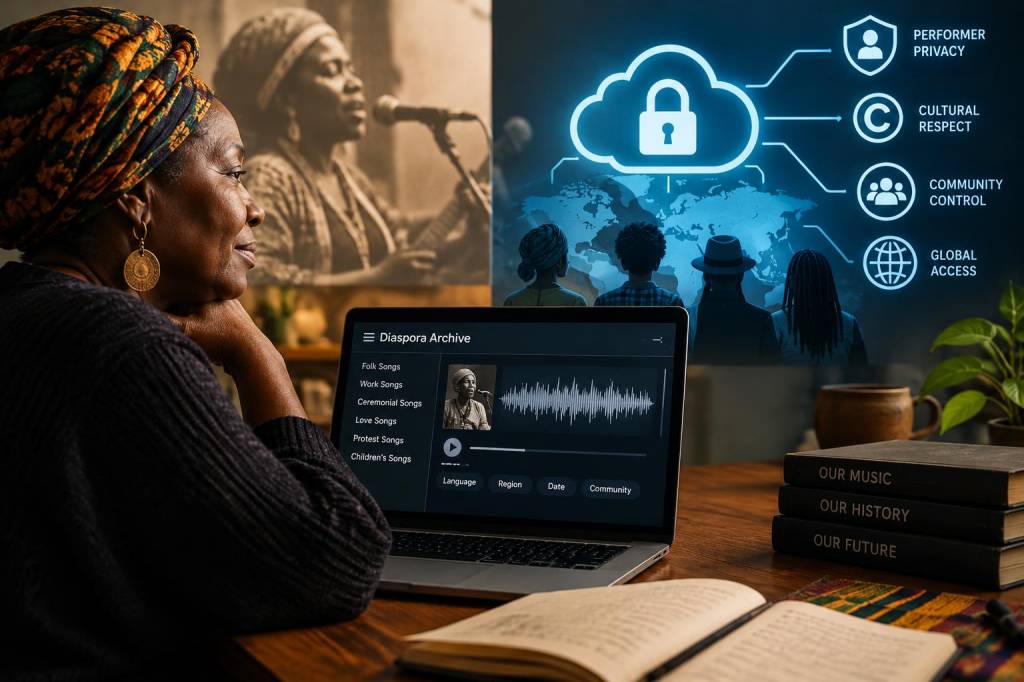
I have spent enough time around archives to know that preservation is never a neutral act. Every recording, every transcript, every label attached to a song reflects a choice: what gets saved, what gets described, who gets named, who gets omitted, and who gets access later. When I think about a diaspora archive holding endangered songs, I do not see a simple repository. I see a living ethical question. Can an archive protect music that might otherwise disappear, while also protecting the people who carry it from cultural theft, misrepresentation, and unwanted exposure? My answer is yes, but only if the archive is built around consent, shared authority, and real limits on access.
I have worked on cultural projects long enough to know that endangered songs often survive in fragile conditions. They may live in private memory, in family gatherings, in ritual settings, or in the bodies of elders who have never written them down. Diaspora communities often become accidental custodians of this material. Migration scatters singers, interrupts intergenerational transmission, and creates distance from original contexts, but it also produces new networks of care. A diaspora archive can gather fragments from different cities, languages, and generations into one place. That sounds valuable, because it is. Yet the same act of gathering can also make songs easier to extract, copy, or flatten into marketable “heritage” content.
What worries me most is the false idea that documentation automatically equals protection. A recording deposited in an archive may be safer from physical loss, but it may also become easier to download, repackage, or republish without permission. I have seen cases in which songs collected with community goodwill later appeared in academic databases, documentary soundtracks, festival programming, or commercial samples with little or no benefit returning to the singers. In those moments, preservation becomes a gateway to exploitation. The archive was meant to defend memory, yet it ended up increasing visibility in ways the performers never intended.
That is why I think any diaspora archive must begin with a very different question: not “What can we collect?” but “What do people want to safeguard, and what do they want to keep private?” Those are not the same thing. A performer may want a song preserved for descendants, language learners, or ceremonial continuity, while refusing open online circulation. Another may welcome broad access but only with proper naming, contextual notes, and community oversight. A third may prefer that a song remain undocumented except in a restricted family archive. None of these positions is less legitimate than the others.
Consent must be active, not assumed
In my view, the most important safeguard is ongoing consent. A single signed form is not enough, especially when archives outlive the circumstances in which they were created. Many performers do not want a one-time legal waiver that strips them of control forever. They want a relationship. They want a chance to change their minds. They want to know who will hear the recording, under what conditions, and for what purpose. That means the archive must treat consent as a living process, not a box to tick.
I would build any responsible diaspora archive around layered permissions. Some materials could be public. Some could be visible only to registered community members. Some could be accessed only with approval from named custodians. Some could be sealed for a period of time. A flexible system respects the fact that songs are not identical objects; they often carry different degrees of ritual, personal, political, or commercial sensitivity.
Here is the practical logic I keep returning to:
| Archive action | Possible benefit | Possible risk |
|---|---|---|
| Open online access | Wide educational reach, long-term visibility | Copying, misuse, loss of contextual control |
| Community-only access | Shared ownership, stronger trust | Limited reach, technical barriers |
| Restricted access with approval | Protection for sensitive material | Slower research process, administrative burden |
| Delayed release | Respects living sensitivities and family wishes | Delayed learning and public visibility |
For me, this table captures an essential truth: there is no perfect model, only trade-offs. The ethical archive is not the one that maximises openness at any cost. It is the one that makes its trade-offs visible and negotiable.
Metadata can protect or expose
People often focus on recordings and ignore metadata, but metadata is where a great deal of harm can begin. A song label can expose clan names, sacred affiliations, exact village origins, performance contexts, family relationships, or geographic routes that some communities prefer not to publicise. Even seemingly harmless details can become dangerous when aggregated. A scattered family history can be pieced together by strangers. A local ritual song can be detached from its protective context and turned into a sample pack, a soundtrack cue, or a social media trend.
When I describe this risk to colleagues, I like to say that metadata is not administrative dust. It is power. The archive should therefore allow communities to decide which fields are public, which are hidden, and which are stored under different levels of access. A performer may want the song title visible but not the performer’s full legal name. Another may want lineage noted but not location. Another may request that linguistic annotations be reviewed by trusted speakers before publication. This is not excessive caution. It is cultural self-defense.
There is also the issue of translation. In diasporic settings, songs are often translated by well-meaning researchers who do not fully understand their social life. I have seen translated lyrics stripped of metaphor, ceremony, humor, and coded references. Once that happens, outsiders may assume they understand the song when they do not. Worse, a poor translation can make a song appear free for reuse because its significance has been flattened into generic language. A careful archive must treat translation as an interpretive act that requires community participation, not just linguistic competence.
Ownership is not only legal
One reason cultural theft is so difficult to prevent is that law and lived experience do not always align. A recording might belong to an institution under copyright, while the song itself remains part of a community’s intangible heritage. A performer might sign a release because they need travel money, not because they truly understand the long-term implications. An archive might argue that it is merely preserving material, while community members experience the same action as extraction.
I have come to believe that ownership in this context is not just legal; it is relational. If an archive cannot answer who stewards the material, who decides on access, who benefits from use, and who can revoke permission, then it is not truly protecting anything. It is storing content. Stewardship means return paths must exist. It means community members can request corrections, remove items, add contextual notes, or negotiate new uses after original deposit. It means the archive remains accountable to living people, not just to institutional policy.
One of the most effective models I have seen involves community curators working alongside archivists. The archivist brings preservation skills, technical infrastructure, and cataloguing knowledge. The community curator brings cultural fluency, historical memory, and ethical authority. Neither role is sufficient alone. Together, they can decide what must be safeguarded, what can circulate, and what must remain off-limits. This shared governance does not eliminate tension, but it makes tension visible and productive.
Protection means building friction into access
In much digital culture, friction is treated as a flaw. People want instant search, instant download, instant sharing. But if a song is endangered and vulnerable to theft, some friction is necessary. Access should be meaningful, not effortless. I am not arguing for secrecy as a default; I am arguing for thoughtful barriers that force users to pause, identify themselves, and accept responsibilities before entering sensitive material.
That might mean a request form that explains intended use. It might mean time-limited access that expires unless renewed. It might mean watermarked audio streams that cannot be casually reposted. It might mean community review before publication or citation. It might even mean refusing online access altogether for certain items and allowing listening only in a supervised setting. These measures are not anti-knowledge. They are anti-exploitation.
I also think archives should educate users about the difference between admiration and entitlement. Too often, people approach endangered songs as if rarity invites possession. They hear a moving recording and immediately imagine remixing it, teaching it, posting it, or programming it. Admiration is not the same as permission. A responsible archive should make that distinction unmistakable.
What communities deserve from an ethical archive
When I think about an archive that genuinely protects performers, I think in terms of obligations rather than features. It should not only store songs; it should support the conditions under which songs remain socially meaningful. That means investing in trust, not just technology. It means budgeting for community consultation, not only software. It means accepting that some material will never become publicly searchable, and that this is a success rather than a failure.
- Shared decision-making about what is collected, described, and released
- Flexible access levels that match the sensitivity of each recording
- Clear benefit-sharing when material is used in publications, exhibitions, or media
- Community review of translations, captions, and contextual notes
- Revision rights so performers can update or withdraw permissions
- Protection against commercial reuse without explicit consent
- Long-term accountability through ongoing governance, not one-off collection
I have no patience for archives that celebrate visibility while ignoring vulnerability. Visibility can be useful, but it can also become a trap. For endangered songs, protection is not only about saving sound from decay. It is about ensuring that the people who sing, inherit, and care for those songs are not stripped of control in the process. A diaspora archive can absolutely serve as a shield, but only if it respects the fact that cultural memory is not raw material waiting to be mined. It is a relationship that must be tended, negotiated, and sometimes kept out of public reach.