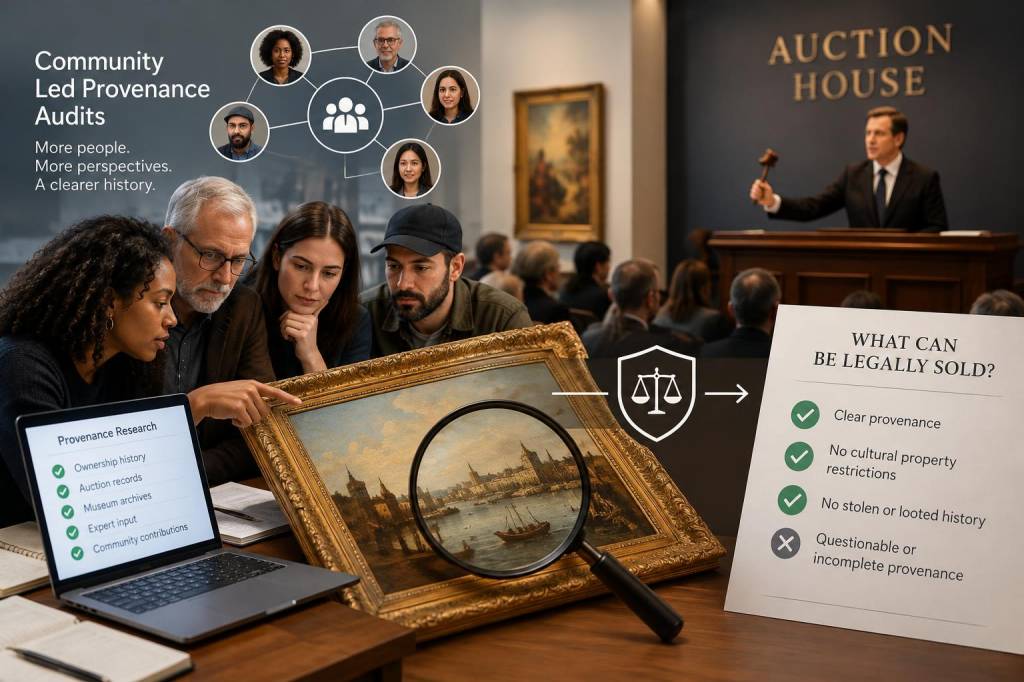
When I first started paying close attention to provenance, I thought of it as a matter of confidence: a cleaner story, a stronger sale, a happier buyer. Over time, I learned that provenance is much more than a marketing layer wrapped around an object. It can determine whether an auction house is allowed to sell something at all. That shift becomes even more powerful when communities lead the audit process themselves.
A community-led provenance audit changes the balance of power. Instead of leaving the historical record solely in the hands of cataloguers, lawyers, and outside researchers, it places knowledge holders, descendants, source communities, and local experts at the centre of the inquiry. In practice, that can expose gaps in ownership records, reveal evidence of colonial removal or wartime looting, and challenge assumptions that a long presence in a private collection automatically makes a sale lawful. I have seen this dynamic reshape not only what gets sold, but what never should have been listed in the first place.
What a provenance audit really does
At a basic level, a provenance audit reconstructs an object’s chain of custody. It asks where the item came from, who owned it, how it moved, and whether any transfer involved theft, coercion, export restrictions, or other legal barriers. A community-led audit expands that question set. It asks what the record leaves out, whose memory counts as evidence, and whether the object’s movement was legitimate according to the laws and ethical standards of the time.
That matters because auction houses often rely on incomplete paperwork. A single receipt, an old collection label, or an inherited family note may be enough to create the appearance of legitimacy. But appearance is not proof. When communities bring oral history, archival fragments, language expertise, and place-based memory into the process, they can identify red flags that a commercial due-diligence review might miss.
I find that the strongest audits do not begin with suspicion alone. They begin with attention. Who made the object? Who used it? Who lost it? Who still has a relationship to it? Those questions can move an item from being treated as a neutral commodity to being understood as a living part of cultural history.
Where legality becomes fragile
An auction house can only legally sell an item if it has a defensible right to offer it, and if no law blocks the transaction. That sounds straightforward, but in heritage matters, the legal picture is often layered and uneven. Domestic property law, export controls, museum acquisition rules, wartime restitution claims, indigenous cultural heritage protections, and international conventions can all intersect.
Community-led audits can change the legal status of a sale in at least four ways.
- They may uncover evidence that the object was stolen, looted, or unlawfully excavated.
- They may show that the object left its country of origin in breach of export laws.
- They may reveal a repatriation claim or a pending restitution dispute.
- They may establish that the object belongs to a category of cultural material subject to special protection or ownership rules.
Once any of those issues is documented, an auction house may have to pause a sale, withdraw the lot, notify authorities, or engage in negotiation with claimants. In some cases, continuing with the sale could expose the house to civil liability, regulatory action, reputational damage, or even criminal risk, depending on jurisdiction and facts.
Why community knowledge changes evidence
One reason these audits are so disruptive, in a productive sense, is that they expand what counts as evidence. Auction houses often prefer written documentation because it is easy to file and easier to defend. Communities, by contrast, may offer testimony, family memory, ritual knowledge, photographs, song, scarification patterns, language naming, and site-specific expertise. That material is not decorative. It can be decisive.
I have long believed that the legal world sometimes underestimates the force of contextual knowledge. An object may not be described accurately in a catalogue because it is misidentified, renamed, or stripped of its origin. A community member may know that a supposed decorative object is in fact ceremonial, or that a pattern on a vessel identifies a specific lineage or region. That knowledge can trigger legal questions about export, ownership, and cultural sensitivity that a simple database search would never raise.
In my view, the most important shift is this: the audit does not merely ask whether a sale is popular or ethical. It asks whether the seller has met the burden of proof. Once that burden starts to wobble, the sale itself becomes legally unstable.
What auction houses are forced to do differently
Community-led audits pressure auction houses to move beyond minimal compliance. A house that once relied on basic catalogue notes may now need deeper due diligence, wider consultation, and more careful risk review. That can mean checking wartime archives, colonial records, customs documents, museum loan histories, dealer files, and published restitution claims. It can also mean consulting with outside specialists who are not part of the sales team.
From a legal perspective, this changes internal decision-making. Instead of asking, “Can we reasonably sell it?” staff have to ask, “Can we prove lawful title and defensible export history if challenged?” That is a much harder standard. It may also lead to an internal veto, even when a seller insists everything is in order.
I have noticed that the most responsible auction houses now understand that silence is dangerous. If a community raises a credible concern and the house ignores it, that silence can later look like willful blindness. In heritage law, willful blindness is often as damaging as direct knowledge, because it suggests a failure to investigate obvious risk.
Common legal pressure points
The precise legal outcome depends on the object, the country involved, and the available evidence, but certain pressure points appear again and again. I keep returning to these because they are where community-led audits tend to hit hardest.
| Pressure point | Why it matters | Possible effect on sale |
|---|---|---|
| Unlawful excavation | Objects removed from archaeological sites without permission may have no lawful trade status | Sale may be blocked or challenged |
| Export restriction breach | Items exported without required permits can be subject to return claims | Lot may be withdrawn |
| Restitution claim | A source community, state, or institution may have a pending ownership claim | House may need to freeze transaction |
| Misattribution | Incorrect identification can hide sacred, protected, or sensitive status | Sale may trigger legal and ethical review |
| Lack of title evidence | Missing chain-of-ownership records weaken the seller’s claim | Buyer risk rises and sale may collapse |
What feels different when communities lead
For me, the most striking difference is tone. Traditional provenance work can feel adversarial, as if the object is a suspect and the archive is a courtroom. Community-led audits often feel more exacting, but also more humane. They make room for grief, memory, and repair. That emotional depth does not replace legal analysis; it strengthens it.
When communities lead, an auction house may be asked to hear not just a claim, but a relationship. That relationship can reveal why an object was never meant to circulate commercially. A mask, a carving, a manuscript, or a burial item may not be merely “rare.” It may be tied to ceremony, identity, or ancestral duty. If that fact is established, the legal question shifts from “Is there a buyer?” to “Was there ever a valid right to sell?”
I think this is where public understanding still lags. Many people assume that if an object is old, private, and well documented enough to be catalogued, it must be legally saleable. Community-led audits show that age and documentation are not substitutes for lawful title. They can even mask deeper problems if the record has been shaped by removal, conquest, or erasure.
What I look for in a serious audit process
Whenever I examine a provenance dispute, I look for certain qualities that signal seriousness rather than performance.
- Clear consultation with the relevant community before any sale proceeds
- Transparent sharing of archival findings, including gaps and uncertainties
- Independent review by specialists without a financial stake in the outcome
- Willingness to suspend or withdraw a lot when doubts remain unresolved
- Respect for oral testimony alongside written records
These are not just ethical preferences. They are risk controls. A house that documents its process carefully is better placed to defend a decision if challenged. A house that rushes ahead despite warnings may find that it has built a legal problem into the sale itself.
I also think buyers have a role here. Collectors increasingly ask for stronger provenance, but they should ask sharper questions. Has a community review taken place? Were concerns raised and answered? Was the object ever subject to cultural property restrictions? Was legal advice obtained from a specialist in heritage law? Those are not awkward questions. They are essential ones.
Community-led provenance audits do not merely polish auction practice. They can redraw the boundary between what is marketable and what is not. In doing so, they remind me that legality in heritage is never only about paperwork. It is about history, power, memory, and responsibility, all pressed into a single object that may look small on a catalogue page but carries a far larger claim on the present.