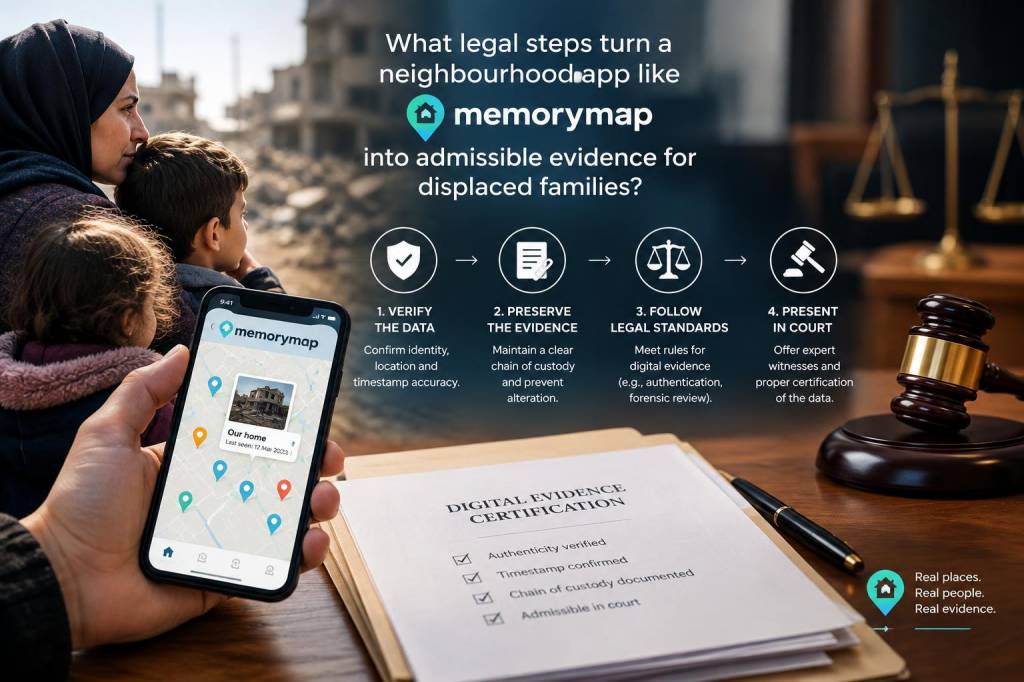
I remember the first time I sat with a displaced family clutching their phones and a printout from a neighbourhood app called MemoryMap. The map markers, timestamps and user notes seemed to hold the kind of granular, contemporaneous information that could prove where people had lived, what was taken from them, or which route was safe when escape was necessary. But would any of that hold up in court?
From years of researching contested heritage and community archives I’ve seen digital traces assume legal weight—and also be dismissed because they lacked the basic forensic scaffolding that courts expect. In this piece I’ll walk you through the practical, legal and ethical steps that can turn a local app’s data into admissible evidence for displaced families. I’m writing from a hands-on perspective: what I would do if I were helping a family, an NGO, or a local volunteer collective to make MemoryMap (or a similar neighbourhood platform) speak in a legal setting.
Understand the legal context first
There’s no single magic trick: admissibility depends on jurisdiction, the type of case (criminal, civil, administrative, asylum), and the specific rules of evidence. In general, courts want reliable, authenticated, and relevant information. So before collecting anything, find out which legal forum you’re aiming for and what rules apply there. If you can, consult a lawyer familiar with digital evidence in the relevant country.
Preserve the original data
Digital evidence is fragile. The first legal step is to preserve the original data in as immutable a form as possible. I recommend the following actions, which mirror practices used by digital forensics teams:
- Make forensic images of devices where data was entered or stored (phones, tablets, laptops). Use established tools (e.g., FTK Imager, Autopsy) or an accredited forensic lab.
- Export data from MemoryMap using the platform’s native export tools where available (CSV, JSON, KML). If the app lacks a formal export, capture screenshots and screen recordings, but treat these as secondary to raw exports.
- Collect server-side data. If MemoryMap stores data on servers, formally request access via the app provider or via legal process (e.g., preservation letter, subpoena). Server logs, database records and backups are often the most authoritative sources.
- Capture metadata. Timestamps, GPS coordinates, device IDs, user accounts and IP logs are all metadata that underpin authenticity. Preserve them alongside content.
Establish chain of custody and documentation
Chain of custody is the paper trail—or digital trail—showing who handled the evidence, when, and how. Without it, even pristine data can be attacked as tampered. Simple steps I insist on:
- Record every action. Create a log documenting who collected what, when, on what device, and using which tools.
- Use secure storage. Store forensic images and exports on encrypted drives or secure cloud storage with access controls.
- Sign and date transfer documents. Whenever evidence moves hands—NGO to lawyer, volunteer to lab—have both parties sign a receipt.
Authenticate the data
Authentication means proving that the MemoryMap data is what it purports to be. Courts often ask: who created this entry, and how do we know it wasn’t altered? Here are routes I’ve seen succeed:
- Correlation with independent sources. Match app entries with photos (with embedded EXIF metadata), CCTV footage, bank records, or witness statements. Converging evidence strengthens authenticity.
- Metadata analysis. Forensic examiners can verify timestamps, GPS coordinates, and device identifiers to show consistency.
- Platform attestation. A signed statement from MemoryMap’s operators explaining storage practices and providing server logs can be compelling. This often requires legal process to obtain.
- Digital signatures and hashing. If you can hash exported files (SHA-256, for example) at the point of collection and preserve the hash, later comparisons can show files haven’t changed.
Prepare witness statements and affidavits
Technical evidence rarely speaks for itself. A good affidavit or witness statement contextualises the data: who made the entry, why, and what it means. For displaced families I encourage:
- First-person statements describing how they used MemoryMap and why entries matter to their claim.
- Expert statements from a digital forensics practitioner who can explain technical methods used to preserve and authenticate data.
- Contextual affidavits from local NGOs or community leaders who can corroborate the circumstances surrounding the entries.
Mind privacy, consent and data protection laws
This is critical. Gathering app data can implicate privacy rules (GDPR in Europe, various local laws elsewhere) and ethical duties to vulnerable people. I always take pragmatic steps to reduce harm:
- Obtain informed consent where possible. Explain how the data will be used, who will see it, and the risks involved.
- Minimise exposure. Redact unnecessary personal information, and use pseudonymisation when preparing public reports.
- Use lawful channels for server data. Don’t ask volunteers to hack or scrape private servers illegally; use preservation letters, MLATs or local legal processes.
Engage technical and legal experts early
One lesson from fieldwork: the sooner you involve a forensic expert and a lawyer, the stronger your case becomes. Experts can set up proper collection procedures and attest to them later in court. Lawyers can craft the right legal requests to platforms and anticipate admissibility challenges.
Prepare for cross-examination and challenges
Courts will test the provenance of app data. Expect defence attorneys or opposing parties to ask whether timestamps can be faked, whether GPS was spoofed, or whether users colluded. Anticipate these by:
- Preserving logs that show the account creation history and IP addresses.
- Documenting the collection process with photos and time-stamped records.
- Securing independent corroboration—neighbors, NGOs, or local institution records.
Consider alternative legal uses beyond court hearings
Not all value is in formal courts. MemoryMap data can inform humanitarian aid, reparations claims, or truth-telling processes. When admissibility in court is uncertain, we can still harness app data to map patterns of displacement, document losses for archives, or support community-led restitution processes. These routes often require less rigid authentication but benefit from the same preservation practices.
Practical checklist I’d use on the ground
| Immediate | Secure devices, make forensic images, export app data, capture screenshots, record chain-of-custody |
| Next 48–72 hours | Hash files, store on encrypted media, contact legal counsel, request server preservation from provider |
| Within a week | Obtain and preserve server logs, collect corroborating evidence, draft witness statements |
| Ongoing | Coordinate with experts, monitor legal requests, ensure ethical handling and consent |
Turning a neighbourhood app into admissible evidence is more than a technical exercise: it’s a legal, ethical and human one. The steps above are practical and field-tested approaches that, when combined, give displaced families the best chance of having their digital traces recognised in formal processes. If you’re working with MemoryMap data and want me to help draft an on-the-ground checklist or liaise with forensic practitioners I’ve worked with, drop a line via the contact page—these processes work best when we build them together with the people whose lives they document.