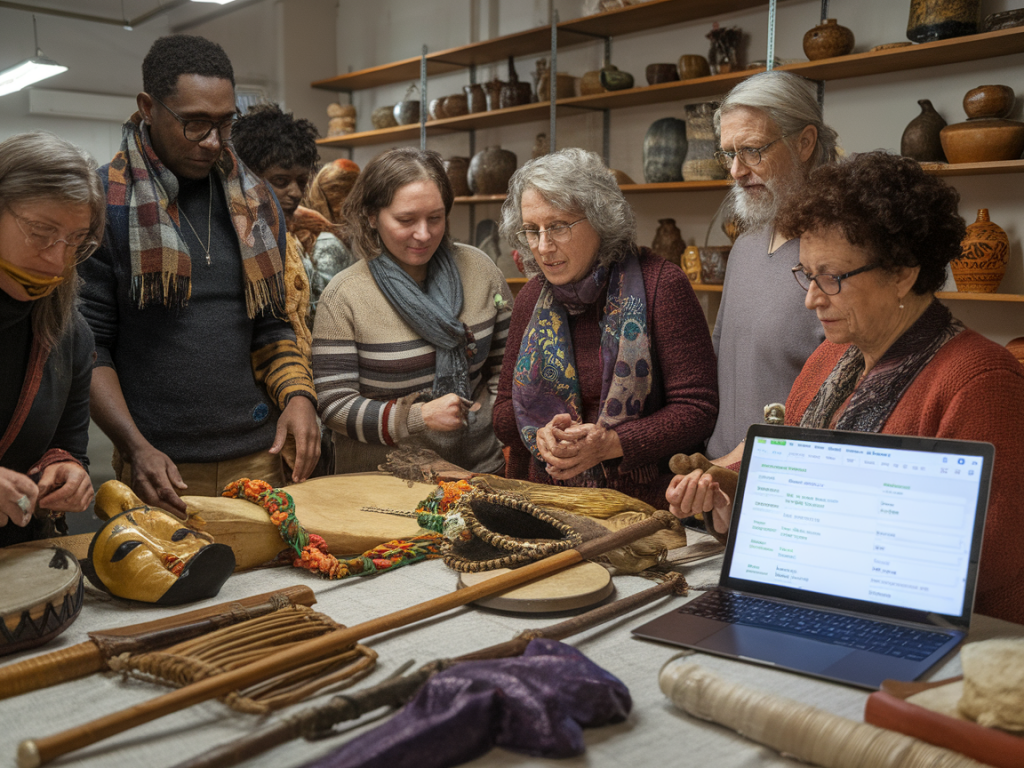
I remember first hearing about archivebridge at a small gathering of curators and community archivists in Lisbon. Someone passed a phone around and pulled up an interface that looked deceptively simple: photos, place names, oral notes, and a timestamped trail. What struck me was not the slick design but the confidence in the room — people who had long felt excluded from institutional narratives were suddenly the authors of a shared record. That image has stayed with me as I’ve been thinking about a pressing question: can a community-led cataloging app like archivebridge actually stop the looting of ritual objects?
What archivebridge promises
At its core archivebridge is a tool designed to enable communities to document objects, practices and places in ways that foreground local knowledge. It’s not just a database: it’s a workflow for collecting photographs, contextual descriptions, oral histories and geolocated provenance. The idea is to create a decentralized record that can be consulted by researchers, museums and — crucially — by communities themselves.
There are a few practical promises here that often get repeated:
How documentation can deter looting — and how it can’t
Documentation is a tool, not a panacea. When objects are well-documented and that documentation is widely shared, they become harder to sell on anonymous markets. A detailed record that ties an object to a ceremony, a named maker, or a specific site increases the risk and reduces the profit for traffickers. In some cases, visible records have led to the interception of objects at borders or the removal of illicit listings from platforms like eBay or Etsy.
But documentation also has limits. Looters motivated by local poverty or by organised networks will not be stopped by a record alone if there’s no enforcement mechanism. Digital records can be ignored, obscured or falsified. There’s also the uncomfortable reality that publicising the existence of certain objects may increase their desirability on illicit markets — a phenomenon anthropologists have called "the publicity paradox".
Community control vs. exposure risks
One of the central tensions I’ve seen is between the need to document and the need to protect. Community-led cataloging puts control in local hands: decisions about what to record, who can see it, and which metadata are public are meant to be governed by the communities themselves. That is a significant ethical improvement over extractive documentation by outside researchers.
Yet the danger is real. Photographs of a concealed ritual object, its precise GPS coordinates, or recordings describing a cache can be used by those with malicious intent. A responsible app needs granular permissions, offline modes, and the option to redact or anonymise sensitive elements. Archivebridge’s architecture — as presented in demos — tries to address these concerns through tiered access and community-managed visibility settings. In practice, how those settings are implemented and maintained will determine whether the app protects or exposes at-risk heritage.
Evidence, provenance and legal leverage
One of the most convincing arguments for community-led cataloging is its potential to provide provenance evidence. When a museum or buyer is confronted with a contemporaneous record showing an object in situ or connected to a named community, that carries weight. National customs agencies and international platforms like the Art Loss Register increasingly rely on digital records to flag suspicious items.
However, provenance documentation produced post-hoc — after an object has already been removed — is less effective. The timing of the record matters. The strongest deterrent is a persistent, auditable trail that predates an illicit sale and that is recognised by institutions involved in art and antiquities trade. This is where partnerships with museums, law enforcement, and digital platforms matter: an app’s data needs to be interoperable with existing registries and legal frameworks.
Practical questions people ask
Real-world examples and precedents
There are precedents where community-led documentation has made a difference. In parts of West Africa, local registries documenting sacred groves and ritual masks have been used to aid repatriation claims. In Australia, Indigenous-run databases of cultural objects and place names have strengthened legal protections under native title claims. These examples show that when documentation is coupled with legal recognition and advocacy, it becomes a lever for protection.
Conversely, there are cautionary tales. In some regions, photographic surveys intended for conservation were later used to identify high-value artifacts for looters. Those mistakes underline the need for robust ethical protocols and for treating documentation as an act of stewardship, not simply data collection.
Technical considerations that matter
For an app like archivebridge to be effective, several technical features are non-negotiable:
| Feature | Why it matters |
|---|---|
| Encryption | Protects sensitive cultural data from unauthorised access |
| Persistent IDs | Creates traceable records useful in legal and market contexts |
| Offline mode | Enables documentation in remote or insecure areas |
| Metadata standards | Ensures interoperability with museums and registries |
Where partnerships make the difference
Technology alone can’t close the loop. To deter looting effectively, community-led catalogs need institutional allies: customs agencies alerted to the registry, online marketplaces that respect takedown requests, and museums willing to check community databases before acquisitions. There are already promising initiatives where NGOs and platforms cooperate to flag illicit listings — but much more coordination is needed, especially across borders.
Crucially, communities must not be treated as mere data providers. Partnerships must include capacity-building, legal support and funding to sustain the archives they create. Too often, digital projects are launched with fanfare and then abandoned, leaving communities exposed and records inaccessible.
Practical steps communities and allies can take now
When I think about the broader landscape, I’m cautious but hopeful. Community-led cataloging apps like archivebridge bring an essential shift: they return narrative agency to people who have long been written about rather than listened to. If implemented with humility, technical rigour and equitable partnerships, they can raise the bar for provenance and make illicit trade harder. If handled poorly, they risk amplifying the very threats they’re meant to stop. The work, as ever, happens in the messy intersections between technology, law and people — and that’s where careful, community-centred design can make a real difference.