Why this question matters
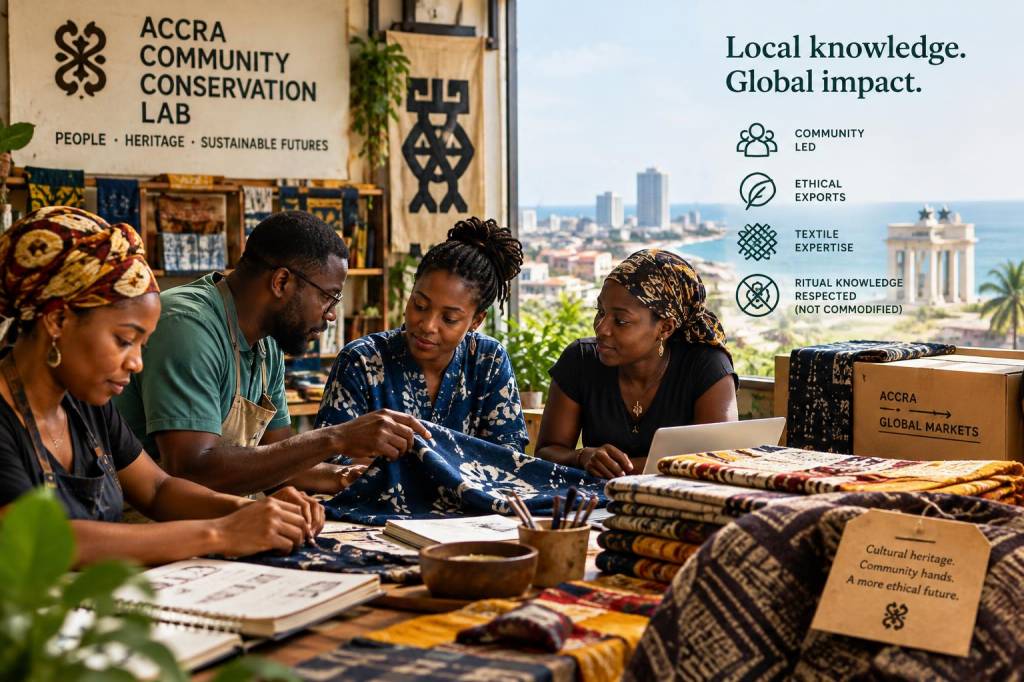
When I first visited a community-run conservation lab in Accra, I was struck by a tension that felt both practical and ethical: how to teach and share specialist conservation skills with the wider world without turning sacred textiles and their ritual meanings into marketable curiosities. The lab was doing incredible work—stabilising fragile kente cloths, documenting dye recipes, training local technicians—but every decision about publication, workshop attendance or commercial partnership risked sliding from respectful knowledge exchange into commodification.
This is not an abstract dilemma. People ask: Can technical know-how be exported without stripping sacred contexts? Who benefits when expertise is packaged and sold? How do you prevent intellectual and cultural appropriation while still creating livelihoods and building global conservation networks? These questions are urgent for cultural workers, curators, community leaders and donors alike.
Principles that should guide any export of expertise
From my time on the ground, four principles seem indispensable:
Consent and community governance: The community must lead decisions about what knowledge is shared, with whom, and under what conditions.Contextual integrity: Technical instruction cannot be stripped of the ritual, social and symbolic meanings that give it significance.Reciprocity and benefit-sharing: Any economic or reputational gains from exported expertise should materially support the community.Capacity building over extraction: Training should prioritise local agency—equipping community members to teach and control dissemination.Practical measures to implement those principles
Translating principles into practice requires a mix of governance mechanisms, pedagogical design and contractual safeguards. Here are specific steps I’ve seen work or can recommend:
Community-led Memoranda of Understanding (MoUs): Before any workshop or partnership, create a clear MoU outlining what knowledge is shared, attribution rules, fees, and what remains confidential. The MoU should be written in accessible language and approved by elected community representatives.Tiered knowledge-sharing: Not all knowledge has to be public. Think in layers: - Surface-level techniques (safe to share broadly): handling protocols, environmental controls, basic stitching for stabilisation.
- Restricted techniques (shared under agreement): specific ritual repair methods, dye recipes with sacred significance.
- Protected knowledge (not shared): elements deemed sacred or secret by the community.
Community curators as trainers: Rather than external conservators traveling to Accra to “extract” expertise, support paid community curators and conservators to lead workshops abroad or online. This retains authority and economic value locally.Ethical licensing and benefit-sharing clauses: If techniques become part of publications, online courses or commercial products, include licensing fees, royalty shares or co-authorship arrangements that return value to the community.Non-disclosure and culturally appropriate IP tools: Conventional copyright may not capture the nuances of ritual knowledge. Consider bespoke contracts that mix NDAs with cultural protocols, and explore community trademarks for lab methodologies linked to the lab’s name (e.g., “Accra Textile Care Method — community certified”).Digital stewardship with access controls: For photographic and database documentation, use tiered access: public catalogues for general info, restricted archives for researchers with community consent, and a closed repository for ritual materials.Ethnographic accompaniment: Pair technical training with cultural briefings—oral histories, narrated videos, or community-hosted talks—so learners understand the living context around techniques.Transparent pricing models: If the lab offers paid training, make pricing and distribution transparent. Offer scholarships, sliding scales or community priority places.Modes of export that protect ritual integrity
Not all forms of knowledge transfer are equal. Here are approaches that safeguard ritual meaning while allowing expertise to circulate.
Train-the-trainer residencies: Invite international conservators to Accra residencies where they learn under community instructors. Return visits can cement ongoing relationships and ensure proper contextual understanding.Modular online courses: Create a modular curriculum where basic conservation principles are freely available, while advanced modules that touch on sensitive practices require community-approved enrollment and fees that support the lab.On-site hosting rather than displacement: Encourage institutions to hold workshops in Accra rather than moving objects or people abroad. The surrounding social and ritual environment is part of the learning.Co-authored publications and credits: Any technical paper or media piece should list community authors, co-researchers and translators. Preferably, produce outputs in local languages alongside English.Economic models that avoid commodifying ritual knowledge
A lab can create sustainable income without turning ritual knowledge into a product for souvenir-hungry markets. These models emphasize stewardship over sale.
Fee-for-service conservation: Offer professional conservation to museums and private collectors with contracts that stipulate non-disclosure of ritual-sensitive details and commit a portion of fees to community programs.Certification and consultancy: Develop a certification program for “community-endorsed textile care” that institutions value—similar to ethical sourcing labels. Certification fees fund the lab and community initiatives.Ethical workshops and cultural tourism: Host limited-attendance, community-led workshops where participants learn context-rich skills and pay premium fees that directly support local artisans and oral historians.Grants tied to community priorities: Structure grants so funds support infrastructure, apprenticeships and archival projects decided by the community.Red flags and pitfalls to avoid
Not every collaboration is benign. Watch for these warning signs:
One-off extractive research visits: Short-term visits with no follow-up or benefit to the community often lead to appropriation.Unclear ownership of records: When institutions claim sole ownership of photographs, dye formulas or recordings, communities lose control.Commercial branding without consent: Using ritual motifs or process names in products without consent commodifies the intangible heritage.Language barriers and tokenism: If community voices are translated or quoted without context, their authority is diluted.Questions people ask, answered
Will sharing techniques inevitably commodify ritual knowledge? No. Sharing technical skills can enhance preservation and livelihoods when governed by community protocols that distinguish between techniques and sacred contexts.
Can a community lab build global expertise without losing control? Yes—if the community retains leadership over training, documentation, licensing and economic distribution. Models that place community members as lead trainers are critical.
How do you prove ethical practices to international partners? Transparent MoUs, public reporting on benefit distribution, community co-signatures on publications and visible leadership in trainings all help build trust.
What role can museums play? Museums should be partners, not patrons: fund capacity building, host reciprocal residencies, adopt lab-developed conservation standards, and honor licensing and attribution agreements.
| Stakeholder | Good practice |
| Community lab | Lead governance, set tiers of access, host trainings |
| International museum | Support residencies, respect MoUs, pay fair fees |
| Researchers | Obtain consent, co-author, share data access |
I don’t pretend there are neat answers—these are ongoing negotiations, and sometimes tensions remain. But if ethical export is treated as a design problem rather than a marketing opportunity, community-run labs in Accra and elsewhere can become global hubs of expertise that preserve both material textiles and the living meanings they embody.