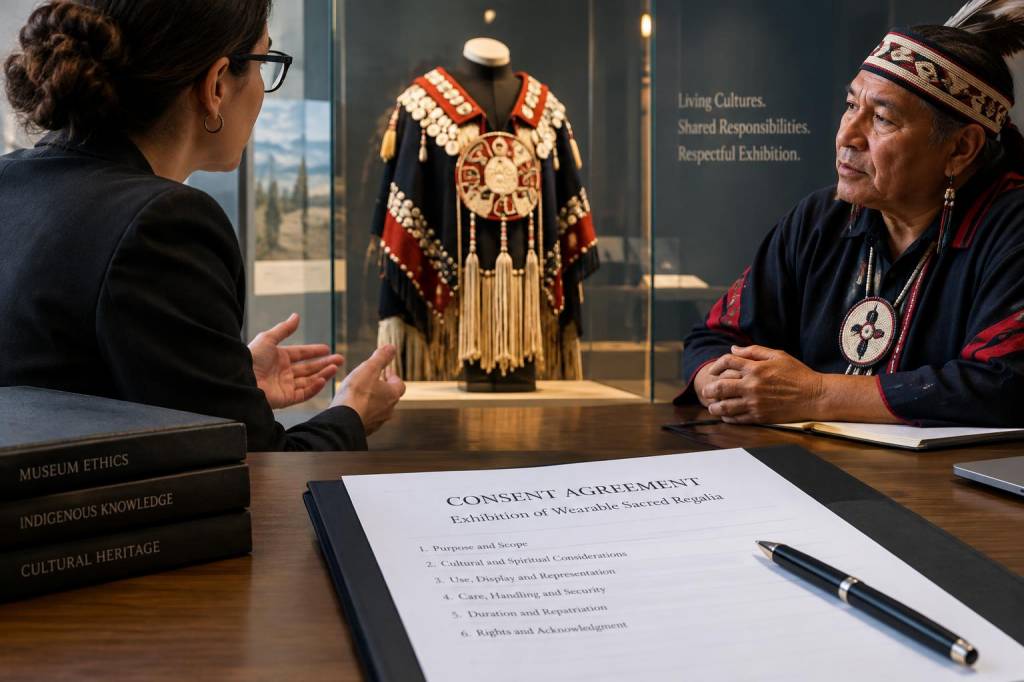
When I first began working on exhibitions that included living ritual specialists lending their sacred regalia, I quickly realised that a standard loan form from a museum’s collections team wouldn’t cut it. These objects often carry active meanings, prescriptive uses, and social obligations that don’t sit neatly within the legalistic language institutions default to. Drafting consent agreements in these contexts is as much about building trust and respect as it is about managing risk.

Start with relationships, not paperwork

I always begin by emphasising that the agreement is a tool to document what we have already discussed in person. It should confirm mutual understandings reached through conversation, not introduce unfamiliar terms that feel coercive. Before anything is written, I spend time with the ritual specialists or their representatives. We talk about the regalia’s life, uses, limits, and the significance of particular materials or marks. That conversation directly shapes the language of the consent.

Key elements I insist on including

Below are the clauses that, in my experience, are essential. I recommend writing them in clear, accessible language and providing a short plain‑English summary for each clause so nothing is lost in legalese.

  • Parties and ownership: Explicitly name the lender(s), their community or lineage if relevant, the institution, and the curator or contact person. State who holds legal title and who claims customary or spiritual custodianship.
  • Purpose and scope of use: Define precisely how the regalia will be displayed, whether it can be worn for live demonstrations, contextualised with explanatory text, or used in interpretive programmes. If the object is never to be worn outside ritual contexts, say so unequivocally.
  • Duration and extension: Specify the loan period, with clear renewal mechanics. Include scenarios for short‑term loans for events and longer loans for exhibitions spanning years.
  • Condition reporting and handling: Agree on condition reporting before and after the loan, and on permitted handlers. If the lender requires that certain people (elders, specialists) handle or oversee handling, make that part of the agreement.
  • Transport, packing, conservation: Who is responsible for packing, transport, and conservation decisions? For sacred wearables, the lender may insist on the presence of a named ritual specialist during packing or unpacking; build that requirement in.
  • Display environment and placement: State environmental controls (light, humidity), storage protocols, and whether the item can be displayed alongside particular objects or images that might be disrespectful.
  • Photography, recording and reproduction: Specify whether photography, audio‑visual recording, or 3D scanning is permitted. For many ritual objects, reproduction can be deeply problematic—either forbidden or permissible under controlled circumstances. If reproduction is allowed, define approval processes and any royalties or credits.
  • Public interpretation and label text: Agree on who drafts label text and public materials. For living traditions, co‑authored interpretive content or recorded quotes from the ritual specialist can be part of the loan agreement.
  • Remuneration and community benefits: Be explicit about any fees, honoraria, travel costs, or community benefits (such as training, conservation skills, community access, or touring opportunities). Payment is not a simple transaction; it recognises labour, expertise, and custodianship.
  • Religious or ceremonial restrictions: Record any calendar restrictions (e.g., cannot be displayed during certain seasons), or prohibitions (e.g., may not be shown to children or photographed by women/men), and how the institution will accommodate them.
  • Revocation and emergency return: Define a clear process allowing lenders to request a temporary withdrawal or permanent return under specified conditions, including timelines and transport responsibilities.
  • Confidentiality and sensitive knowledge: If the regalia is associated with secret or restricted knowledge, include clauses limiting what will be shared publicly and who can access the object in storage or on display.
  • Dispute resolution: Establish mechanisms for resolving disagreements, favouring culturally appropriate mediation before litigation.
  • Insurance and indemnity: Clarify insurance cover, deductible liabilities, and who bears costs for damage or loss. Consider culturally appropriate valuation methods rather than only market value.
  • Intellectual property and moral rights: Address ownership of images, recordings and interpretive texts. Include moral rights provisions allowing the lender to request removal of images or content that misrepresents the tradition.
  • Exit strategy and legacy: Specify post‑loan obligations, such as returns, options for permanent repatriation, or transfer to community custody, and what happens to digital reproductions or cataloguing data.
  • Language, format and accessibility

    Write the agreement in the lender’s preferred language when possible. If translators are engaged, note that the translated version is the authoritative document for the lender and retain both texts. Use plain language and avoid institutional jargon. Provide a one‑page summary and a recorded briefing where possible, so non‑literate participants can still fully consent.

    Examples and templates I use

    I find it useful to include a simple table summarising the clause, why it matters, and the practical outcome. Below is a small example I often adapt:

    Clause Purpose Practical Outcome
    Photography Protects sacred restrictions and controls dissemination No photography during display; approved professional shoot with lender present; images stored with access controls
    Handling Ensures ritual protocols are respected Named ritual specialist to supervise handling; only certified staff may touch the object
    Revocation Allows lender to withdraw object for spiritual reasons 24–72 hour response for temporary withdrawal; institution covers transport

    Co‑creation of interpretive materials

    I never present an object of living ritual without inviting the lender to contribute to interpretive materials. That might mean co‑written labels, recorded interviews, or a short film. Build approval workflows into the contract that define turnaround times for feedback. If the lender requires veto power over certain phrasing, accept that as part of ethical practice rather than an impediment.

    Compensation and non‑monetary reciprocity

    Remuneration should be negotiated transparently. I’ve seen institutions offer honoraria, travel costs, accommodation, and fees for participation in public programmes. Equally important are non‑monetary benefits: conservation training, digitisation of community archives, or funded community access days at the museum. Make these benefits specific and measurable in the agreement.

    When things go wrong

    Despite careful drafting, conflicts can arise. Common flashpoints include unauthorised photography, misinterpretation in press coverage, or sudden spiritual concerns from the lender’s community. The agreement should include an agreed escalation path—start with immediate notification, temporary removal if requested, then culturally appropriate mediation. I also build in a provision for rapid, respectful corrective public statements if harm occurs.

    Practical tips for implementation

  • Use participatory language—“we will” rather than “the lender shall.”
  • Provide a copy of the signed agreement to the lender in physical form and electronically.
  • Train frontline staff and security in the specific protocols related to the regalia.
  • Document conversations: minutes, audio recordings (with permission), and translated summaries help avoid misunderstandings.
  • Build a review date into the agreement for mid‑loan check‑ins; living cultures evolve and circumstances change.
  • Financial risk management, legal protections and conservation standards are important, but they should never eclipse the ethical obligations we hold to living custodians. A well‑crafted consent agreement is at once a legal document and a testimony to care—one that recognises the living relationships that make these objects meaningful. When done right, it enables institutions to share powerful cultural forms with the public while honouring the authority and dignity of those who entrust us with their sacred regalia.