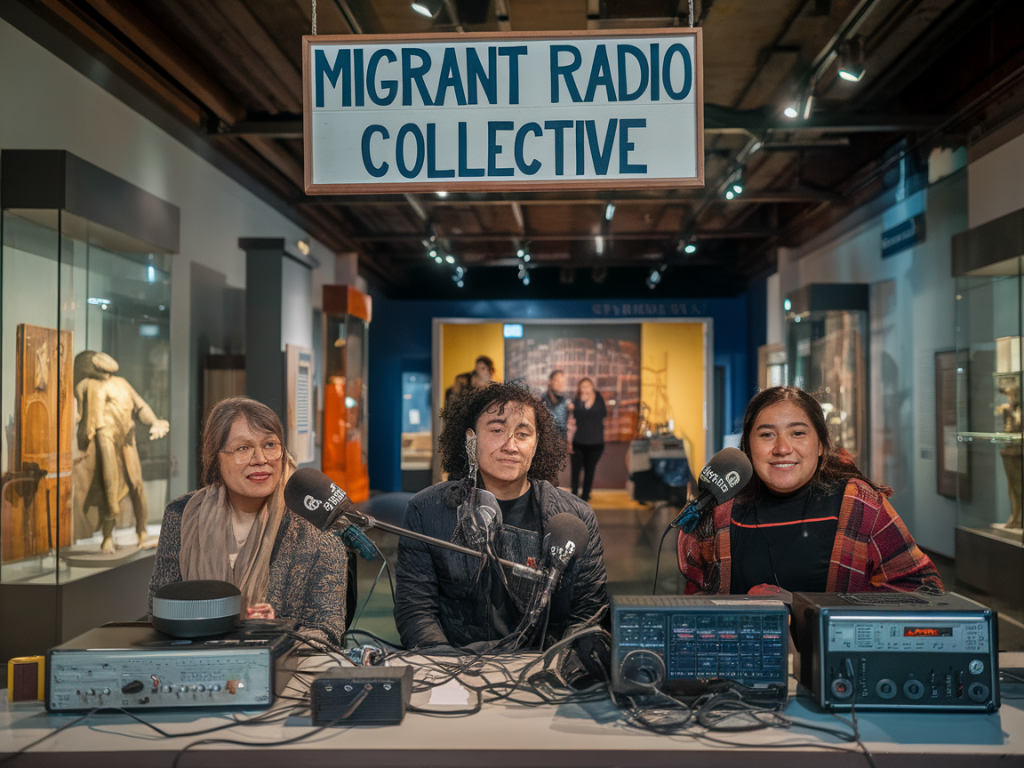
I first walked into the city museum expecting the usual: glass cases, carefully lit panels, a chronology that smoothed out conflict into a tidy timeline. What I found instead, a few months later, was a foyer alive with voices — not from an audio guide but from a radio booth built into a temporary exhibition, broadcasting interviews, music and memories recorded by a migrant-run collective. That unlikely collaboration reframed how the museum talked about labour: from abstractions of policy and industry to lived, noisy, and sometimes contradictory stories of work, dignity and survival.
Why did a museum welcome a migrant radio collective?
People often ask how a traditional museum ends up partnering with a grassroots media project. In this case the museum was wrestling with a gap: its displays on labour history focused on factories, union banners and economic statistics, but it failed to represent the precarious, often invisible labour of migrants — domestic workers, carers, gig economy couriers, seasonal labourers — who keep a city functioning. A local collective, Radio Migrant Voices (a pseudonym for the group), had been producing weekly programmes for years. They approached the museum with an offer that felt both modest and radical: set up a recording space in the building, let us invite workers to tell their stories, and put those stories back into the public circulation of the museum.
The idea appealed to curators searching for authenticity and to community organisers who wanted visibility. For me, the move was interesting because it shifted the museum from being a place that simply displays objects to a platform that records and amplifies living heritage.
What did the radio collective actually do inside the museum?
The collective did three things at once: they created live broadcasts, conducted intimate oral-history interviews, and trained museum staff and volunteers in community-centered audio practices.
- Live broadcasts: The collective installed a small but professional booth using accessible gear — a Zoom H6 recorder, Shure SM58 microphones and a pair of headphones — and transmitted weekly shows from the museum foyer. The programmes mixed music, testimonies and on-the-street segments.
- Oral-history sessions: They curated a series of recorded interviews with workers across sectors: care workers, kitchen staff, seasonal fruit pickers, warehouse operatives. These recordings were edited into looping soundscapes that played inside the labour exhibition, challenging the silence of the cases and labels.
- Skills exchange: Perhaps the most consequential element was training. Members of the collective ran workshops for museum staff on ethical oral-history practice, consent, editing and how to handle multilingual interviews.
Those workshops changed backstage behaviours. Curators learned to listen differently — to slow down, to negotiate consent in multiple languages, to expect contradiction rather than neat narratives.
How did this change the museum’s labour narratives?
There are three overlapping shifts I observed: thematic, methodological and institutional.
Thematic: The exhibition was reconfigured to acknowledge labour’s multiscalar and transnational nature. Labels began to pair archival photos of factory floors with first-person audio clips from migrant workers who had never worked in factories but whose labour undergirded the city in other ways. Text panels started to question who is counted as a 'worker' in official histories.
Methodological: The museum moved from an extractive model — take objects, interpret them, display conclusions — to a participatory model that sees exhibition as a networked conversation. The radio collective’s editing choices, their refusal to neatly sanitize testimonies, introduced ruptures into the museum’s storytelling. Visitors encountered contradictory voices: pride and fatigue, nostalgia and anger, humour and grief. That messiness made it harder to reach tidy conclusions, but it made the narratives truer.
Institutional: Importantly, the museum's staffing and programming practices changed. Staff job descriptions were updated to include community liaison and language-access responsibilities. The museum launched paid internships for contributors from migrant backgrounds, and budgeting lines for community-led commissions became permanent rather than project-bound.
What challenges did the partnership face?
No collaboration is without friction. I’ll be candid about the difficulties I witnessed — they reveal as much about power as any success story does.
- Gatekeeping and risk aversion: Some trustees worried about broadcasting politically sensitive testimonies inside an institution that relies on public funding and corporate sponsors. The collective had to negotiate editorial independence and proof that the museum wouldn’t censor or co-opt stories.
- Language and translation: Many contributors spoke multiple languages. Translating live broadcasts and editing for accessibility required time, budget and skilled translators. Subtitles and bilingual transcripts were necessary but costly.
- Emotional labour and ethics: Recording traumatic experiences is ethically fraught. The collective insisted on trauma-informed consent, follow-up support for contributors, and clear agreements about ownership and reuse of recordings.
- Sustainability: Funders loved the project when it was new; sustaining salaries for community radio producers inside a museum budget was harder. The collective had to diversify income streams — membership drives, small grants, and partnerships with local radio stations.
How did visitors respond?
Visitor responses were mixed but instructive. Some regular museumgoers were initially disoriented — they expected objects and chronology, not live voices recounting recent working lives. Others were deeply moved; people lingered in front of the soundscapes, sometimes leaving their own recordings in a 'response booth' set up nearby.
One moment stays with me: an older man, formerly employed in the port, who heard a young woman describing precarious gig work. He walked up to the booth after the broadcast, pressed his palms flat on the glass and said, "I didn’t think they had it like this." He stayed for two hours, listening and then interviewing a volunteer who had been a courier. The museum had become a space for intergenerational exchange.
What tangible outcomes emerged?
- New archival collections: The oral histories were accessioned into the museum's permanent archive, catalogued with community co-authorship. This created a living repository that future researchers can interrogate.
- Policy influence: A report based on the recordings contributed to a city council review on workers' rights in the hospitality and care sectors. Policymakers cited first-person testimonies in debates — a rare instance where qualitative cultural material directly influenced policy discussions.
- Cultural ecosystem strengthening: The collaboration expanded local media ecosystems. The collective trained other neighbourhood groups in low-cost radio production, using equipment donated by community-minded companies like Rode and Zoom.
- Public imagination: The museum’s labour narratives shifted from distant epochs to a present that visitors could feel. That has ripple effects: public empathy, new community partnerships, and more equitable curatorial practices.
What lessons did I take away?
If I had to distil this partnership into principles they’d be these: openness to risk, commitment to ethical practice, and willingness to let institutional stories be unsettled. Museums that want to engage with contemporary labour realities must be ready to lose some control. They must honour the messy, contradictory testimony of people who work at the edges of visibility.
I also learned that technology can be a democratising force when used thoughtfully. The relatively low barrier to entry for basic audio gear — a USB mic, Audacity editing software, an inexpensive field recorder — means that community groups can craft compelling media without corporate infrastructure. Yet technology alone isn’t enough. It must be paired with structures that value labour: decent pay for producers, proper archiving, and meaningful decision-making power for contributors.
Finally, the collaboration reminded me why institutions matter. Museums are not neutral containers; they are producers of social memory. When they open their spaces to marginalised voices — and when they commit to the hard work of sharing power — they can reshape how a city remembers its workers, and who gets to be counted in that memory.