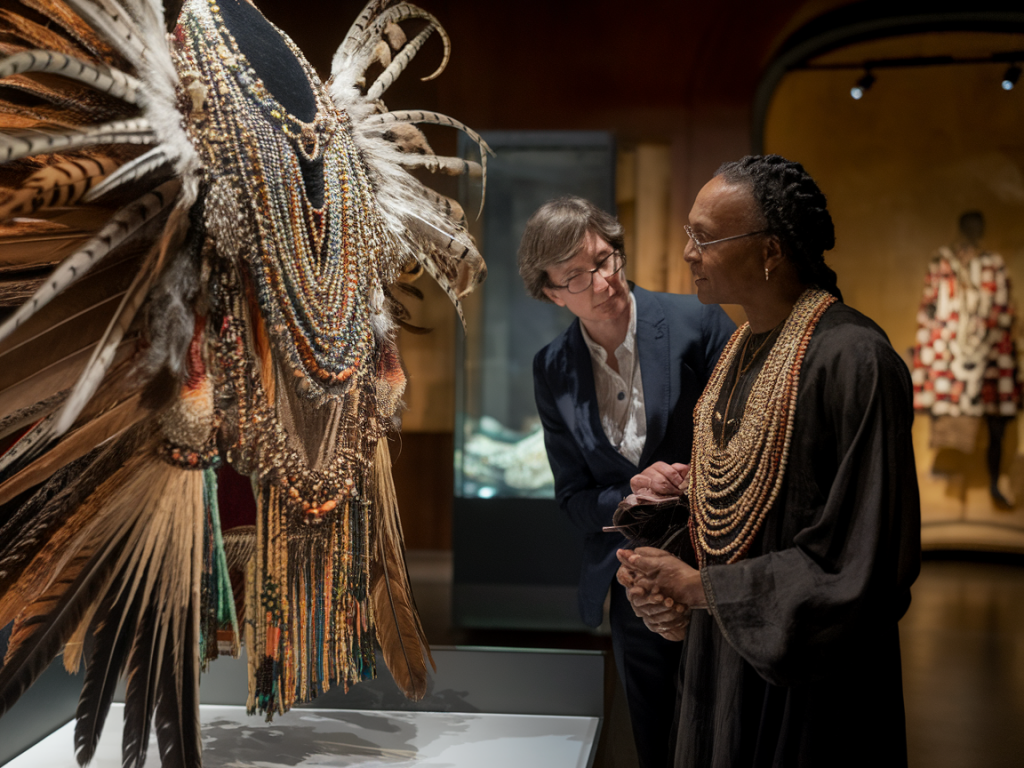
I remember the first time a ritual specialist from a West African diaspora community handed me a textile wrapped in plain brown paper and said, softly, “This cannot be looked at like other museum pieces.” The garment was a living object — stitched with prayers, altered over years of use, its threads carrying names and requests. I learned, in that moment, that consent is not a single checkbox but a conversation that starts long before the object crosses a gallery threshold and continues long after the display closes.
Why consent for wearable sacred regalia is different
Wearable sacred regalia are not neutral artifacts. They are activated through touch, sound, breath and ritual context. In diasporic settings especially, these objects often carry layered meanings: they are family heirlooms, tools for spiritual practice, markers of social roles, and sometimes forms of resistance against erasure. Asking for them to be loaned to a gallery imposes a new set of risks — misinterpretation, desacralisation, or even harm to the communities who entrust them to institutions.
That’s why, for me, negotiating consent must be relational, culturally informed and iterative. It’s not enough to rely on standard loan forms or blanket institutional policies. Curators and cultural workers need to build processes that respect the owner’s agency and the object’s living context.
Foundational principles I use
Practical steps to negotiate consent — a workflow I’ve used
Below is a pragmatic sequence that has guided my practice. It’s not prescriptive but provides a structure to adapt with humility and listening.
What should be in the consent agreement?
| Topic | Key points to include |
|---|---|
| Purpose | Clear statement of exhibition aims, dates, and venues |
| Display conditions | Lighting, orientation, proximity to other objects, use/non-use of mannequins |
| Handling | Who may touch, rituals prior to handling, training for handlers |
| Photography & media | Allowed uses, restrictions, third-party licensing, social media policy |
| Reproduction rights | Permissions for publication, digital surrogates and commercial use |
| Compensation | Fees, travel costs, community benefits, capacity-building |
| Revocation | Process to request changes or withdraw consent |
On mannequins, mannequins alternatives and display choices
One of the trickiest decisions is whether to display wearable regalia on mannequins. Mannequins can secularise or anonymise an item. For some communities, a garment should never be 'posed' on an inanimate form. In other cases, a well-chosen mannequin, dressed in consultation with the lender and possibly customised by an artist from the community, can be permissible and even empowering.
Alternatives include:
Handling photography, press and public programming
Photography is often assumed as part of exhibitions, but for sacred regalia, public images can be harmful — shared out of context, used inappropriately, or appropriated commercially. I always ask whether public photography is permitted, and where it is not, we communicate this clearly in signage and with staff. For press and marketing, we request the lender’s approval of images; sometimes a controlled photo session with community supervision is the best route.
Public programming should centre community voices. I prefer to hire ritual specialists or community curators as paid contributors for talks, guided tours and workshops. This is both respectful and ensures the narrative remains rooted in lived knowledge.
Compensation and reciprocity
Consent negotiations should include meaningful compensation. That might be a loan fee, travel reimbursement, or funding for community projects and archives. It can also be non-monetary: training museum staff, facilitating access to conservation expertise, or digitisation of family records. I try to be explicit about budgets from the start so negotiations are honest.
When consent is refused or conditional
Refusal must be respected without pressure. Conditional consent requires careful documentation and ongoing monitoring. In a recent project, a lender allowed an item to be displayed only if a named elder was present during opening hours. We reorganised rotas, factored in payment and saw the arrangement deepen public engagement — visitors could ask questions and learn from an authoritative voice.
Final thoughts on accountability
Curating sacred regalia from diasporic ritual specialists asks us to move beyond procedural compliance to moral accountability. For me, good practice is not about ticking boxes; it’s about centring relationships, continuing to listen, and being prepared to adapt institutional practices in response to community needs. The object’s permission is inseparable from the people who gave it life.