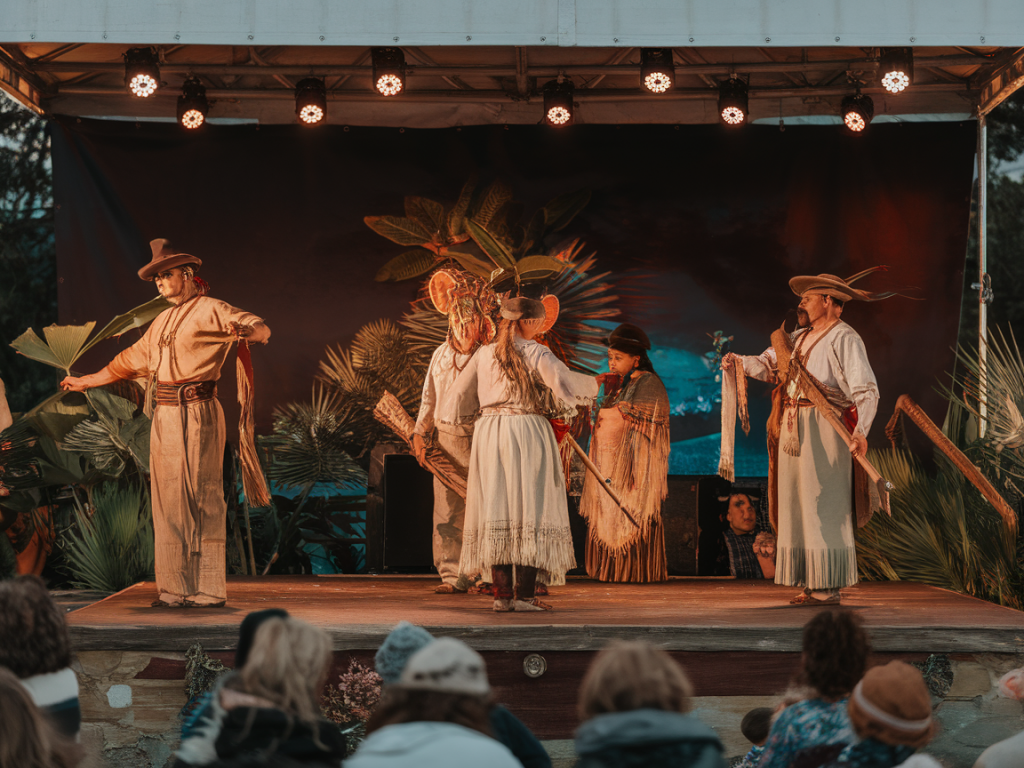
When a funder asks me whether they should back a biennial that commissions living sacred performances, my first response is not a quick yes or no. These are projects that move between aesthetics, ritual, community authority, and legal and ethical responsibility. They demand sustained curiosity and humility. Over the years I’ve learned that the right questions—asked early and honestly—can mean the difference between generative partnership and harm disguised as cultural ambition.
Why “sacred” matters as a category
“Sacred” is not merely a stylistic tag. It names practices, relationships and obligations that sit within specific cosmologies and communal sovereignties. Funders should begin by recognising that sacred performances often have living custodianship: elders, ritual specialists, faith communities and hybrid contemporary practitioners who hold knowledge, consent and boundaries.
Core questions funders should ask
- Who defines the sacred in this context? Is the biennial partnering with the custodial community or only with an artist who claims inspiration? A clear mapping of authority prevents extractive narratives.
- Have you secured informed consent at the community level? Consent is not a one-off signature. It requires ongoing dialogue about intent, form, duration, audiences and future uses (recordings, archives, merchandising).
- What are the risks to the community and to participants? Risks can be spiritual, reputational, legal or economic. Identifying them early shapes mitigation: rehearsal protocols, audience management, or even the decision not to publicise certain elements.
- How are artists and ritual specialists remunerated? Is compensation fair, transparent and culturally appropriate? Token fees for sacred labour reproduce the same inequities that arts funding claims to address.
- Who controls the recording and dissemination? Some sacred acts are never meant to be filmed or distributed. Clarify rights, permissions and archival access before production begins.
- Does the project require specialist pastoral care? Sacred performances can be physically and emotionally intense. Build budgets for care: spiritual advisors, counsellors and safe spaces for debrief.
- How will the work be evaluated? Traditional KPIs (attendance, press) are insufficient. What does success mean to the community and the artists? Co-design impact frameworks.
- What’s the exit strategy? Funding often has a short horizon. Who will steward relationships after the biennial ends?
Practical structures and red lines
Beyond questions, funders need practical tools. I recommend establishing protocols that become part of the commissioning process.
- Community Memoranda of Understanding (MoUs) — documents that outline roles, permissions, ownership of ritual elements, and dispute resolution mechanisms.
- Ethical advisory panels — panels including community representatives, practitioners, legal counsel and cultural mediators who can review proposals before clearance.
- Safeguarding policies — adapted for spiritual contexts: what constitutes spiritual harm, and how to respond when boundaries are breached.
- Transparent budgets — budgets that list fees for ritual specialists, pastoral care, travel, compensatory payments to custodial communities, and contingencies for cultural protocol requirements.
Financial questions: what to fund, and how much?
Money shapes relationships. Funders should be explicit about what they are willing to finance and why. Here is a simple budgeting matrix I’ve used as a starting point with partners:
| Category | Rationale | Typical allocation (%) |
|---|---|---|
| Artist fees (including ritual specialists) | Respectful compensation for labour and knowledge | 25–40% |
| Community engagement and advisory | Honoraria, meetings, local coordination | 10–20% |
| Pastoral and safeguarding | Counselling, spiritual care, safety measures | 5–10% |
| Production and rehearsal spaces | Appropriate venues respectful of practice | 10–20% |
| Documentation and archiving | Controlled recording, community access | 5–10% |
| Contingency | Protocol shifts, additional permissions | 5–10% |
These percentages are indicative; the right split depends on context. What matters is that allocations reflect values: the custodians must be paid and protocols resourced.
Questions about artists, curation and boundaries
Commissioning artists who work with sacred material requires careful curatorial framing. Some useful prompts:
- Does the artist have an established relationship with the tradition or community? If not, what steps will be taken to build trust and demonstrate accountability?
- Are there cultural or religious red lines? Identify non-negotiables early and respect them in the brief.
- Is the work being presented in a way that respects ritual order? Timing, spatial orientation and the presence of community custodians may all be essential.
- How will the curatorial text and marketing frame the work? Tone matters. Sensationalising “exotic” practices is disrespectful and damaging.
Documentation, ownership and legacy
Funders must insist on clear agreements about documentation. Recording sacred performances without community consent is an all-too-common ethical failure. Ask:
- Who may record and for what purposes?
- Who owns the recordings and how will they be accessed in the future?
- Will the archive be controlled by the community, the artist, or the organiser?
Imagine a scenario where a ritual song recorded for a biennial ends up in a commercial sample library; the reputational and spiritual consequences can be profound. Protecting provenance and access must be contractual.
Legal and insurance considerations
There are practicalities that can’t be ignored. Funders should ensure the project has:
- Appropriate public liability and event insurance that understands ritual elements
- Clear contractual clauses about indemnity, cancellation and force majeure that consider sacred timeframes (some rituals cannot be rescheduled)
- Copyright and moral rights arrangements that respect communal authorship, where relevant
Evaluation beyond numbers
Measuring success for living sacred performances requires qualitative tools. I favour mixed evaluation methods co-designed with communities:
- Reflective interviews with participants and custodians
- Community-led impact statements
- Practice-based reflections from artists (audio journals, process notes)
- Audience learning logs for invited or participatory elements
These approaches centre relational outcomes—trust, reciprocity, recognition—rather than purely attendance figures.
Red flags that should give funders pause
- Short deadlines that pressure rapid cultural extraction.
- Lack of community representation in decision-making bodies.
- Requests to record or reproduce elements that custodians explicitly prohibit.
- Tokenistic inclusion of ritual specialists without proper compensation or authority.
Supporting sacred performances through a biennial can be one of the most rewarding forms of cultural philanthropy: it opens publics to living cosmologies, invites new aesthetic vocabularies and can repair historical marginalisation. But it requires funders to move beyond checkboxes and embrace relational labour: listening, redistributing resources and accepting that sometimes the most generous act is to fund an ongoing process rather than a single spectacle.