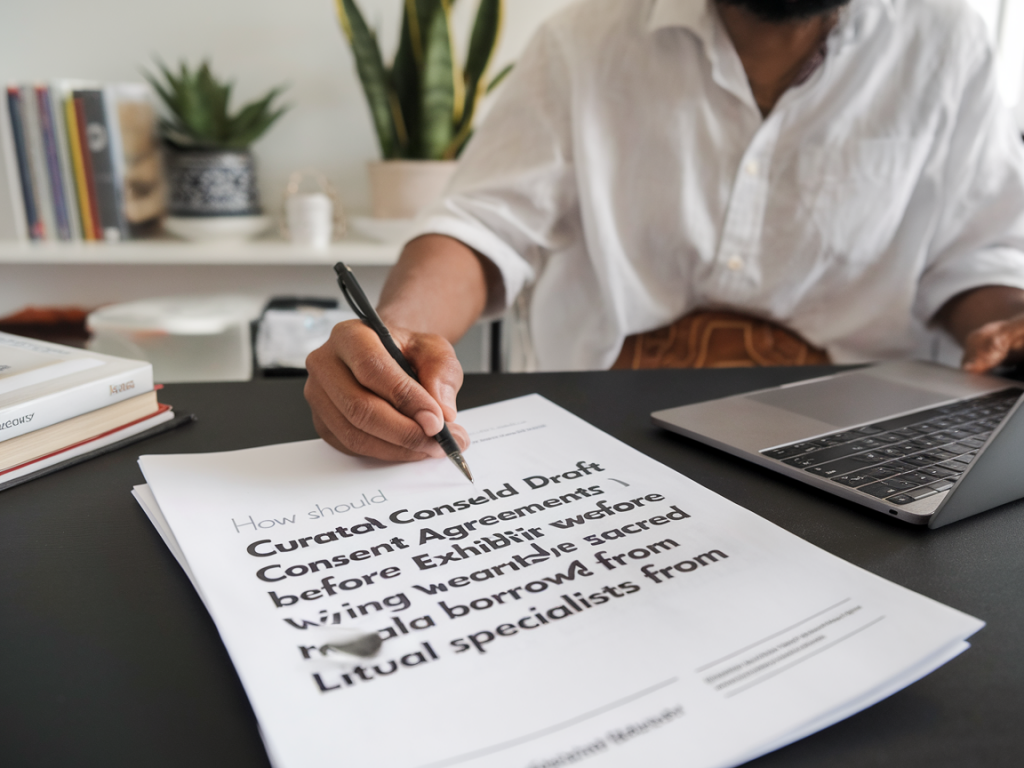
When museums or galleries ask to borrow wearable sacred regalia from living ritual specialists, I always feel a mix of exhilaration and responsibility. These objects are not just artifacts; they are active participants in belief systems, embodiments of lineage, and sometimes, attachments to people's identities and livelihoods. Drafting consent agreements in such cases is less a bureaucratic hurdle and more a form of care work: a negotiated promise that recognises human relationships, spiritual protocols and legal realities.
Start by listening—really listening
My first rule is simple: before a draft is ever written, sit down with the ritual specialist and their community. That meeting should be about listening, not about presenting museum templates. Ask open questions: What does this object mean? When and how is it used? Who else needs to be consulted? What are the spiritual boundaries around visibility, touching, photography, or the presence of certain people in the room? In my experience, those conversations reveal priorities that never appear in standard loan forms.
Make the agreement relational, not merely transactional
Language matters. I avoid legalese-heavy templates and aim for plain, respectful prose. The agreement should read like a relationship charter: it names the parties, states shared intentions, and records commitments on both sides. Use first-person plural where appropriate (“we will…”)—it humanises the document. Include a clause that acknowledges the living authority of the lender and any community oversight mechanisms they insist upon.
Core clauses I always include
- Purpose and scope: Specifying why the item is being exhibited, for how long, and the educational/public programme attached to it. This anchors future decisions.
- Provenance and authority: Record the lender’s relationship to the regalia—lineage, custodianship—and any spiritual claims. If a community council must ratify decisions, say so.
- Access and handling restrictions: Clear instructions about who may handle the object, what PPE or conservation protocols are required, and whether the object may be worn or only displayed. If handling requires a specialist (for example, a community-appointed attendant), specify who pays them.
- Photography and reproduction: Define permitted forms of recording (visible photography, video, 3D scanning), audiences, and uses (archival, promotional, research). I often include separate permissions for in-gallery photography by visitors versus institution-controlled documentation.
- Display conditions: Lighting, humidity, mannequins vs. flat display, and whether the object may be displayed with unrelated items. If the regalia must be displayed in a darkened room or not shown to certain genders, specify it.
- Ritual use and periodic access: If the regalia is still used in ceremonies, schedule leave periods or allow for abrupt returns for ceremonial use. Some communities require objects to be present at seasonal rites; the agreement should permit that.
- Repairs and treatments: Consent for conservation interventions must be explicit. Where possible, include joint decision-making procedures and offer options for community-approved conservators or training for in-house staff.
- Credit, voice and interpretation: Require that label texts, catalogue entries and audio guides credit the lender and include their voice or approved interpretation. Where community members want authorship or co-curation credits, spell that out.
- Financial arrangements: Cover transport, insurance, conservation costs and, if relevant, fees or honoraria. Transparent budgets avoid later resentment.
- Privacy, secrecy and off-limits information: If parts of the regalia are secret/sacred, specify what must remain hidden from public view and what can be spoken about. Consider redaction clauses for published materials.
- Duration, renewal and early termination: State precise loan periods and renewal procedures, and include a clause allowing immediate return if spiritual emergencies arise.
- Dispute resolution: Prefer community-based mediation or culturally appropriate arbiters rather than abstract legal procedures, while also noting legal jurisdictions if needed.
Be specific about photography, digital surrogates and reproductions
Digital images complicate consent in profound ways. A single social-media post can ripple globally. I include tiered permissions: one tier for museum-controlled documentation (high-resolution photography, 3D scanning) for conservation and outreach; another for interpretive images used in promotion; and a prohibition or restriction on visitor photography where required. If 3D models are allowed, say whether they can be sold or used in commercial partnerships. Specify metadata and copyright: many community partners want to retain copyright or insist on Creative Commons clauses limiting commercial use.
Care, conservation and training
Wearable regalia often incorporate organic materials that need bespoke care. I always require a joint conservation plan: condition reporting before and after loan, agreed treatment protocols, and funding for necessary conservation. When a community prefers its own stewards to travel with an object (to perform care, to advise staff, or to lead handling), include travel, accommodation and per diem arrangements. If the museum plans to train staff in particular ritual protocols, detail the training scope and compensation.
Language, translation and interpretation
Draft the agreement in the lender’s preferred language as well as the institution’s language. Professional translation prevents misunderstandings that later become disputes. For interpretive texts, include a provision that gives the lender review and approval rights over labels or displays that explain sacred meanings.
Financial justice and honoraria
Borrowing sacred regalia often extracts value—cultural, spiritual and sometimes intellectual. I advocate for honoraria for the lender and for community contributors, fair fees for consulting, and revenue-sharing if commercial activities arise (e.g., catalogue sales, merchandising). These payments should be negotiated transparently and paid promptly.
Community oversight and co-curation
I prefer agreements that institutionalise ongoing community involvement: advisory committees, periodic reviews, and shared programming budgets. When communities co-curate, they should have veto power over misrepresentations. For living ritual specialists, this control can be essential to safeguarding not only the object but the practices attached to it.
Sample clause headings for a quick visual
| Clause | Purpose |
|---|---|
| Parties & Authority | Identify lender(s), institution, and community body |
| Object Description & Provenance | Detailed inventory and lineage |
| Access & Handling | Who may touch, under what conditions |
| Display & Interpretation | Permissions for labels, lighting, context |
| Recording & Reproduction | Photography, scanning, publication rights |
| Conservation & Treatments | Pre-agreed protocols and conservator choices |
| Financial Terms | Fees, insurance, transport, honoraria |
| Ritual Use/Return | Scheduled use, emergency returns, renewals |
| Dispute Resolution | Culturally appropriate mediation |
Finally, treat the agreement as living. Too often institutions view documents as static shields; I prefer them as living frameworks that can be amended by mutual consent. Regular check-ins, clear points of contact, and a shared email trail help prevent miscommunication. When done well, these agreements protect objects and, crucially, the people to whom they matter. They are acts of respect as much as they are legal safeguards—and that distinction changes everything.