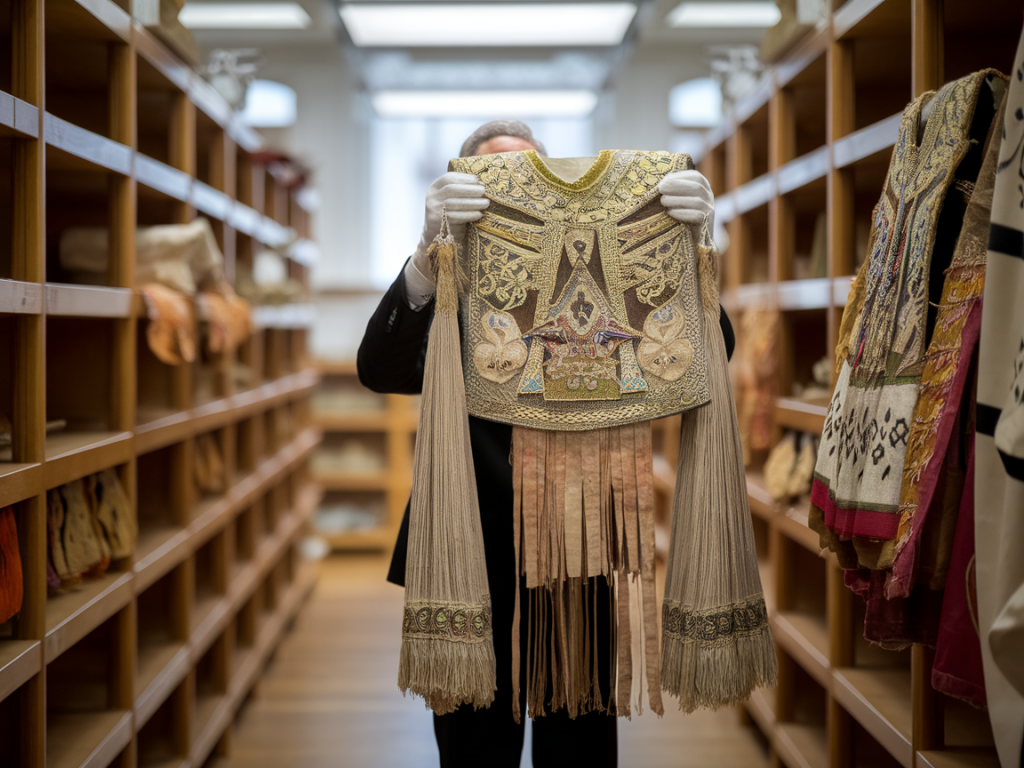
I’ve spent a long time thinking about objects: how they carry meaning, how they travel, and how their meanings can be transformed — or damaged — when they move into different contexts. When a sacred headdress, a carved reliquary or ceremonial garment is requested for use in a commercial film, that moment becomes a test of ethics as much as logistics. Filmmakers see an object as a prop that adds authenticity; communities see it as living heritage. As a curator, navigating that tension requires more than paperwork. It requires care, listening, and procedures that protect both the object and the people to whom it matters.
Start with community consent — and keep listening
Before any legal document is drafted, I always insist on starting conversations with the communities connected to the regalia. Consent isn’t a checkbox; it’s a process. Ask: who holds authority over the object? Is there an elder council, a cultural institution, or families with custodial rights? Don’t assume museum ownership equals moral authority.
These conversations should clarify not only whether the object can be used, but how it can be used. Is it permissible to be photographed at all? To be touched by actors? To be displayed outside ritual context? Some communities allow representation but forbid certain gestures or sequences. Others want script approval or on-set cultural advisers to ensure respectful handling.
Document provenance and sacred status
Good curatorial practice always includes provenance research, but when sacred regalia is in play, the stakes are higher. I make sure the file contains:
- Detailed provenance: acquisition history, donor information, previous loans.
- Condition reports with photographs and notes about structural weaknesses.
- Notes on sacred status: whether the object is active in ceremony, gendered in use, tabooed for certain people to handle, or subject to seasonal protocols.
Sometimes provenance reveals contested ownership or objects removed under colonial conditions. If the history is problematic, I elevate the conversation: does lending the object risk re-traumatising communities? Would a replica or high-quality digital surrogate be more appropriate?
Risk assessment — not just for damage
When assessing risk, I look beyond physical wear and tear. Risks include reputational harm to communities, cultural misrepresentation, and the possibility that an object will be displayed or filmed in ways that violate its sacredness. My checklist covers:
- Physical risks: handling, transport, climate, lighting and stunt use.
- Cultural risks: portrayal, decontextualisation, unauthorized editing.
- Legal risks: international export/import rules, CITES for certain materials, national heritage laws, and repatriation claims.
For many film productions, the easiest mitigation is to use a replica. I’ve worked with prop departments and museums to commission faithful reproductions; this keeps the original safe and gives filmmakers the look they want. If a replica is not acceptable to community stakeholders, the production must accept strict conditions — or walk away.
Contracts that reflect ethical commitments
Contracts matter, but they must be more than boilerplate. I collaborate with legal counsel and community representatives to draft loan agreements that are explicit and enforceable. Key clauses I insist on include:
- Scope of use: precise description of scene(s), purpose, and duration of use. No blanket “for all promotional uses.”
- Approval rights: community and curator approval over filming angles, costume interactions, dialogue that references the object, and final cut for scenes involving sacred items.
- Handling protocols: who can touch the object, what PPE is required (gloves, supports), and on-set environmental controls (temperature, humidity, lighting).
- Transport and storage: secure transport plans, bonded couriers, climate-controlled storage, and restricted access lists.
- Insurance: full-value coverage for loss, theft and damage, plus coverage for reputational or cultural harm where possible.
- Return and condition: timelines for return, post-loan condition reports, and remediation costs for damage.
- Intellectual property and publicity: restrictions on commercial exploitation of the object’s image, credits acknowledging source community, and approval over how the object is described in marketing.
Often I include a clause that the film production will fund a community liaison or cultural adviser for the duration of the shoot — this embeds community presence and shifts power back to source stakeholders.
Insurance, indemnities and financial transparency
Financial safeguards are critical. Insist on a fine-tuned insurance policy that covers not only physical damage but also transport and exhibition liabilities. Check that the insurer understands the object’s value and the particular risks associated with on-location shoots or stunts.
I also recommend transparent accounting for any fees paid to communities or custodians — these should be fair, negotiated, and documented. Token payments risk being interpreted as appropriation; fair compensation recognises labour, cultural knowledge and stewardship.
On-set protocols and training
If the object will be on set, plan for museum-standard handling. That includes:
- Advance site visits so I can assess lighting, sets and risks.
- Briefings for cast and crew about cultural sensitivities and handling rules.
- Restricted access: only named personnel can come near the object; no food, drink or smoking near props.
- Conservation measures: supports, mounts, and padded transit crates; no adhesives, pins or direct attachments unless approved by a conservator.
When I’ve negotiated on-set protocols, I also insist that a conservator accompany the object for transport and handling. This is non-negotiable for fragile or high-value items.
Digitisation and replicas as ethical alternatives
High-resolution digitisation and 3D scanning have changed the game. When communities prefer to avoid lending originals, a digital surrogate can be used for filming and even integrated into VFX. I maintain a network of conservation photographers and scanning labs — from micro-CT to photogrammetry — who can produce assets good enough for close-ups.
Replicas, when made respectfully, can be an opportunity for community artisans. Commissioning a replica can fund local makers and ensure cultural protocols are observed during reproduction. It also eliminates the physical risk to originals and expands creative possibilities for filmmakers.
Publicity, attribution and narrative control
How a film markets an object matters. I negotiate publicity clauses that require:
- Explicit attribution of the source community or museum in credits and marketing materials.
- Language approved by the community about the object’s meaning and context.
- Restrictions on merchandising that uses the object’s image without further consent and compensation.
Sometimes a community will ask for on-screen text, an accompanying documentary feature, or a festival screening invitation so they can respond or contextualise. These requests can feel demanding to producers but they honour the object’s provenance and give viewers a fuller story.
Plan for aftermath: condition reporting and community feedback
Loaning sacred regalia doesn’t end when the truck leaves. I insist on immediate post-loan condition reports with photographs, followed by a debrief with community representatives. This is the moment to acknowledge any unforeseen issues and plan remediation if needed.
I also build into agreements a mechanism for community feedback about portrayal. If a community feels severely misrepresented, the contract can provide for remedies — from on-screen corrections in subsequent releases to funds supporting cultural projects in the community.
When to say no
Saying no is part of stewardship. I refuse loans when: the object’s sacred status makes outward display traumatic; provenance is unresolved and repatriation claims are active; proposed use would misrepresent or commodify beliefs; or the production cannot meet reasonable conservation and cultural conditions.
In those situations, I propose alternatives: replicas, digitisation, access to experts for consultation, or curated contextual materials that can be shown alongside the film. These alternatives often lead to better storytelling — and avoid harm.
Ultimately, lending sacred regalia to commercial film productions requires a balance of legal precision and ethical humility. It’s about protecting fragile materials and the living relationships that make them meaningful. When handled well, such collaborations can be mutually enriching: films gain authenticity and depth, communities gain agency and sometimes resources, and museums uphold their role as mediators of contested histories. But it takes time, patience and an uncompromising commitment to respect.