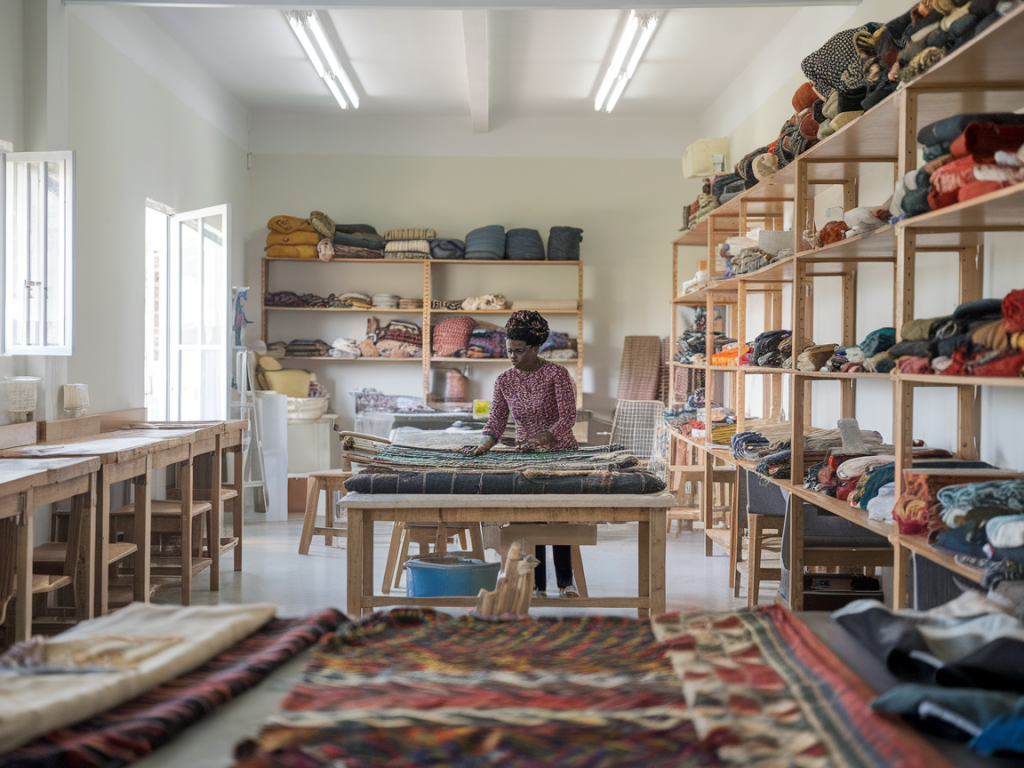
I remember the first time I ran my hands—carefully, with cotton gloves—over a length of handwoven kente in Accra. The colours were stubbornly vibrant despite years of sunlight and handling; the weave held stories of family, ceremony and migration. Yet tucked into that tactile richness were the familiar signs of neglect: insect damage, embrittled selvedges, and makeshift repairs that spoke more of improvisation than conservation. It made me wonder: what would happen if the people who live with these textiles every day were the ones running the conservation lab that cares for them?
Why a cooperative model?
Conservation is often imagined as a specialized, elite practice, housed in institutions far removed from the communities that produced the objects. But textiles—especially living cloths like kente, batik, adinkra, aso-oke—are woven into social life: they’re used at funerals, weddings, markets, mourning rites. A cooperative-run lab in Accra flips the script: it places expertise and stewardship within a collective, locally accountable structure.
There are several reasons a cooperative model makes sense in this context:
- Community ownership: When conservators are members of a cooperative, decisions about priorities and access reflect local values rather than external funders' agendas.
- Shared resources: Equipment and studio space are expensive. Cooperatives pool funds to purchase microscopes, humidification chambers, sewing benches and archival materials.
- Skills diffusion: Rather than hoarding technical knowledge in a vault, members train each other—craftspeople, textile artists, younger conservators—creating a resilient skill base.
- Economic sustainability: Cooperatives can offer paid services—condition reports, conservation treatments, workshops—which generate income to reinvest in the lab.
What would such a lab look like in Accra?
Imagine a converted warehouse near Jamestown or a modest annex attached to a community museum in Osu. Inside, benches line the walls; natural light is supplemented by task lamps. There’s a humidification chamber (a DIY model can be effective), a small oven for consolidating adhesives at gentle temperatures, and toolkits co-designed with local weavers for traditional repair techniques.
But it’s not just equipment. The lab would be governed collectively by members—textile artisans, archivists, community elders, young conservators trained through apprenticeships. Membership criteria could balance technical competency, community involvement and a commitment to open knowledge-sharing.
How do you reconcile traditional repair practices and scientific conservation?
This is the heart of the matter. In Accra, as elsewhere, mending is part of everyday practice. Families mend ceremonial cloths using visible patches or darns that hold social meaning. A cooperative lab needs to respect those practices rather than erase them.
My vision is pragmatic and dialogic: use scientific methods where irreversible decay threatens the object's integrity, and support traditional approaches that reinforce cultural value. That means:
- Documenting traditional repairs and the meanings attached to them before any intervention.
- Prioritising minimal intervention—consolidation, stabilisation—over invasive treatments.
- Designing reversible treatments that mimic or complement traditional aesthetics.
- Working with weavers to develop long-term storage solutions that respond to local climates—natural fibre rolls, breathable boxes with silica gel alternatives, and shading strategies to reduce UV exposure.
Can this be replicable beyond Accra?
Yes—but only if the model is adaptable rather than prescriptive. What makes Accra specific is the interplay between urban craft economies, cosmopolitan art markets, and vibrant ritual life. A cooperative model for textile conservation elsewhere must begin from local knowledge systems.
Replicability rests on four pillars:
- Modular infrastructure: Use affordable, locally available materials to build humidity tents, shelving and conservation tools so labs can be set up with small capital.
- Open curricula: Create training modules—photography for condition reports, simple fibre identification, emergency response—that are freely shared online and translated into local languages.
- Networked support: Establish partnerships with universities, museums and NGOs for periodic mentorship, equipment grants and access to specialised analysis when needed.
- Governance templates: Share cooperative bylaws, revenue models and conflict-resolution frameworks that communities can adapt.
Funding and economic models
One of the most immediate questions is money. How do you fund a cooperative lab without relying exclusively on fickle grant cycles? The answer is mixed funding and earned income:
- Membership dues scaled to ability.
- Fee-for-service conservation for private collectors, galleries and museums.
- Workshops and public programming—for example, paid textile care classes for schools or "repair cafés" where people bring cloths for low-cost stabilisation.
- Commercial partnerships: collaborating with brands—ethical fashion labels investing in heritage preservation can sponsor equipment or commissions that support local makers without extracting cultural capital.
- Micro-philanthropy: platforms like Patreon or Ko-fi could sustain digital outreach and documentation projects.
What are the challenges?
I don’t want to romanticise this idea. There are real obstacles:
- Technical training: High-level conservation requires years of practice. Building rigorous training that also respects local making cultures is time-consuming.
- Climate control: Tropical humidity accelerates deterioration. Low-cost mitigation strategies are necessary but won’t replicate museum-grade storage.
- Market pressures: The commodification of textiles—tourist demand, luxury fashion appropriation—can create perverse incentives to prioritise marketable artefacts over everyday items that carry deep cultural value.
- Legal and ethical issues: Who owns a cloth? Who consents to treatment? The cooperative must navigate kinship rights and communal ownership frameworks sensitively.
Success stories and precedents
There are encouraging precedents. In Latin America, community archaeology projects have integrated traditional knowledge with conservation labs run by cooperatives of artisans and academics. In West Africa, craft centres like the Ghanaian Centre for Cultural Arts have piloted training schemes that blend conservation basics with artisanal skills. These examples show that hybrid models—part craft school, part conservation workshop—can thrive.
One concrete example that could inform an Accra cooperative is the Textile Conservation Centre model used in parts of the UK, which combines training, freelance services and outreach. Adapt the governance to a cooperative structure, decolonise the curriculum, and swap imported supplies for locally sourced alternatives where possible.
What would I want to see happen next?
If I were advising a group in Accra, I’d suggest starting small: a three-month pilot focusing on community-owned funeral cloths and woven heirlooms. The pilot would include:
- Baseline condition assessments and oral histories linked to each object.
- Training workshops—both on preventive care and on documentation methods.
- Public events to share the work with the neighbourhood and solicit donations or commissions.
- Partnerships with one university and one international museum for technical backups.
Document the process with open-access guides and videos. Make the cooperative's bylaws and training curriculum downloadable. If the pilot demonstrates social and economic benefits—repaired textiles returned to families with protective storage, trainees securing paid conservation work—then the model will have a basis for replication.
At stake is more than objects: it's about giving communities the tools to tell their own stories on their own terms. A cooperative-run conservation lab in Accra could be less a single blueprint and more a living laboratory—an approach that combines technical rigour with cultural humility, and that believes stewardship is most powerful when it is collective.