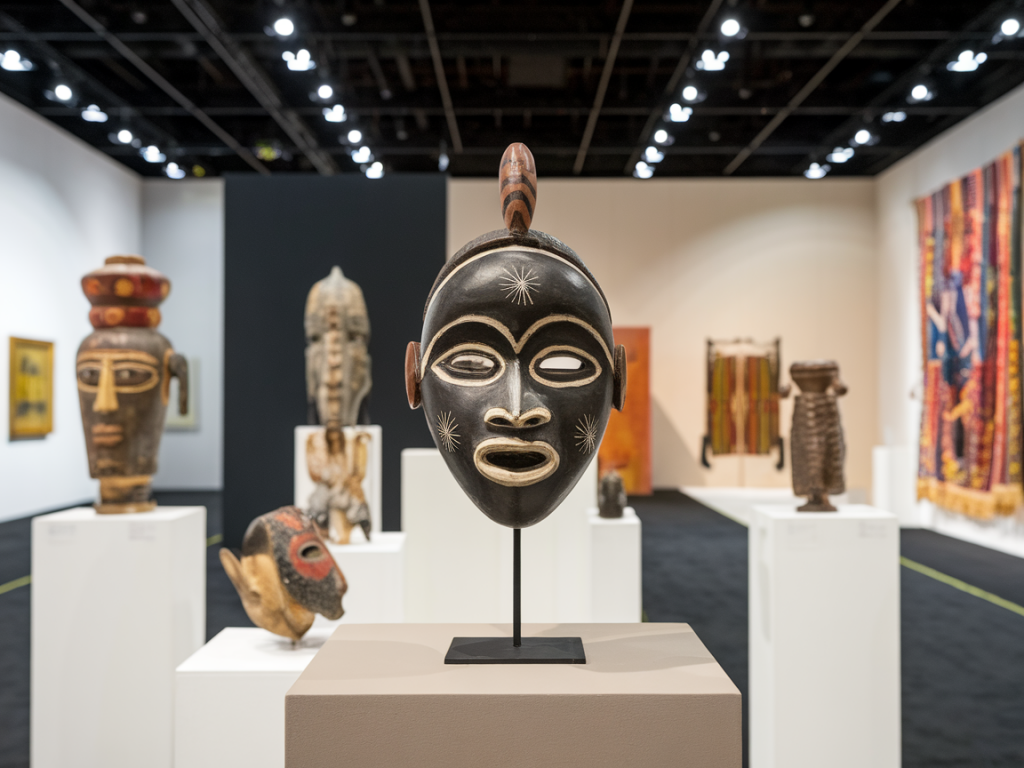
I remember the first time I saw a ritual object displayed beneath pristine gallery lighting at an international art fair. It looked spectacular: lacquered surfaces, intricate beadwork, and a history that seemed palpable in its scars. But alongside that admiration came a knot of unease. How had this object left the community that used it? Who decided it could be exhibited or sold? And crucially, what does it mean to place living traditions into a marketplace designed to turn attention into price tags?
Why this question matters
People often ask: “Isn’t showing ritual objects just part of cultural exchange?” or “Aren’t fairs simply platforms—they don’t create the market?” Those are fair questions, but they miss how display, narrative and commerce are intertwined. A global art fair is not a neutral space. Its audiences, lighting, labels and sales practices shape how objects are read. For living communities, that reading can reframe sacred items as commodities, or worse, strip them of context in ways that cause harm.
Start with relationships, not objects
When I work on projects involving ritual material culture, the first rule I follow is simple: build relationships first, acquire permissions second. This sounds obvious, but many transactions in the global art economy begin with a market impulse and retrofitted ethics. If a fair or gallery wants to feature ritual objects ethically, it must enter into sustained dialogue with the communities who are their stewards—elders, ritual specialists, artists and oral historians—not just dealers.
Questions to ask early on include:
Consent is ongoing, specific and documented
Consent is not a single signed form dropped into a file. It’s an ongoing process that includes clear explanation of how the object will be handled, displayed, interpreted and possibly sold. I’ve seen projects where communities were told an item would be “on long-term loan” only to discover later it had been consigned to an auction catalogue. That kind of breakdown destroys trust.
Ethical practice demands:
Provenance and the politics of acquisition
Legitimate provenance is essential. I always push for rigorous documentation of how an item left its community—was it a gift, sale, or taken?—and whether intermediaries acted ethically. A fair that promotes integrity will refuse objects with murky histories or at least disclose the ambiguities to audiences.
Interpretation that respects and situates
One of the most harmful moves is to aestheticize ritual objects without explaining their social life. Labels that reduce an ancestral mask to “beautifully patinated form” erase the practices that animate it. Instead, fairs should provide layered interpretation: who made/used the object, what it does in its home context, and how contemporary custodians think about its display.
Interpretation should be co-authored when possible. I’ve worked on label texts and interview formats where community members recorded short audio statements to accompany objects—those voices change the emphasis from curatorial proclamation to lived testimony.
Sales, pricing and benefit-sharing
Another set of questions people ask is: “If an object can be sold, is that necessarily unethical?” Not necessarily. People in communities do sell ritual items for various reasons—economic pressures, changing practices, or deliberate decisions to circulate objects. The problem arises when sales are extractive: intermediaries profit while creators and communities see little to nothing.
Practical approaches that I support:
Display protocols and deference
Sometimes objects are not appropriate for public display at all. Certain items may require ritual activation, gendered handling, or specific spatial relationships that gallery environments cannot accommodate. In those cases, the ethical move might be to decline to exhibit, or to create alternative ways of representing the object (detailed photography, 3D scans, community-mediated video) while keeping the original in community custody.
When objects are displayed, fairs should follow handling and display protocols set by custodians. That could mean limiting photography, avoiding pedestalization, or providing spaces for community ritual. Physical placement and lighting aren’t neutral: positioning an object at eye level under dramatic spotlights can change how it’s perceived.
Training, partnerships and transparent curatorial frameworks
Global fairs should invest in staff training on cultural sensitivity, provenance research and ethical sales. Partnerships with museums, universities and community-led organisations can help build capacity. I’ve seen productive collaborations where fair organisers funded community-led research fellowships, or worked with local curators to ensure exhibitions are contextually rich.
| Area | Practical measure |
|---|---|
| Consent | Documented, revocable agreements co-signed by community representatives |
| Provenance | Detailed acquisition histories disclosed in catalogues |
| Revenue | Benefit-sharing clauses; transparent reporting |
| Display | Community-approved protocols; alternatives to display when needed |
| Interpretation | Co-authored labels, audio statements, multilingual texts |
Case examples and lessons
There are good and bad precedents. When museums and fairs have invited community members to co-curate displays, the results are richer and less extractive. Conversely, instances where objects were showcased without consultation have prompted protests and legal challenges. The lesson I draw is that ethical exhibition is not a box to tick but a mode of working that privileges relationships and accountability.
What audiences can do
As visitors and collectors, we can ask better questions. If you see a ritual object in a fair catalogue, ask about provenance, ask whether the community consented, and whether proceeds support custodians. Demand transparency. Markets respond to scrutiny: when buyers insist on ethical practices, dealers and fairs adjust.
Ultimately, the goal isn’t to freeze objects in amber or to romanticise traditions as unchanging. It’s to acknowledge that many ritual objects are part of living systems—systems of meaning, responsibility and care. To feature them ethically at a global art fair requires humility, time, money and a willingness to redistribute power. I’ve seen the alternative: a fast, transactional approach that collapses history into spectacle. I’ve also seen what’s possible when communities are partners rather than suppliers. That difference matters.