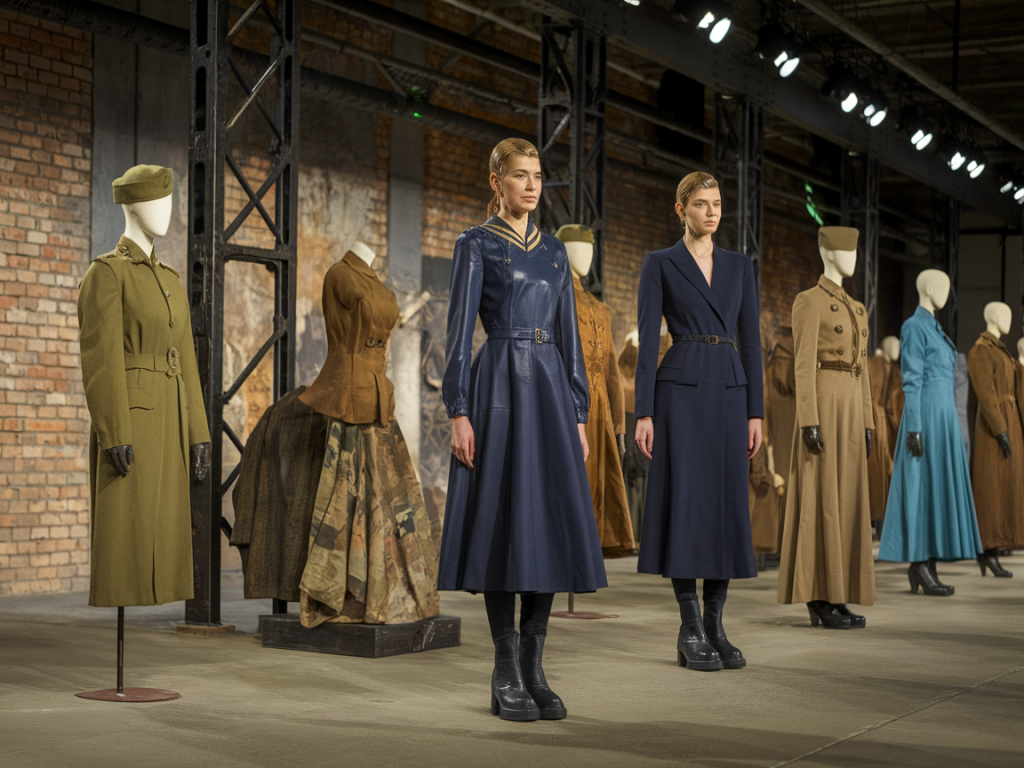
When designers reach into archives for inspiration, they are touching more than fabric and silhouette: they are engaging with lived histories, forms of labor and systems of power. I’ve long been fascinated by the moment a utilitarian garment becomes a runway prop or a luxury capsule — and how that transition can either illuminate or efface the people who made, wore and were constrained by those uniforms. In this piece I want to map how contemporary fashion practitioners can mine archival uniforms responsibly, so that references become conversations rather than erasures.
The appeal of the uniform
Uniforms carry an immediate visual language. A collar, a stripe, a patch can trigger associations with authority, solidarity, service or oppression. Designers from Rei Kawakubo to Thom Browne to Junya Watanabe have long mined military, workwear and institutional garments for their clarity of form and symbolic load. More recently, commercial labels and streetwear brands have co-opted everything from prison jumpsuits to hospital gowns for their shock value or authenticity currency.
That appeal is understandable: uniforms are a ready-made shorthand. But this shorthand is politically and historically dense. When a dress references a nurse’s smock without acknowledging the histories of healthcare labour, or when a military-inspired jacket is stripped of context and cast in luxury leather, we risk aestheticizing — and therefore erasing — the labour and suffering embedded in the original garment.
What erasure looks like
Erasure happens in several overlapping ways. Sometimes it’s literal: a designer copies a patchwork of military insignia and presents it as original without researching who wore the original or why. Sometimes it’s institutional: a fashion house borrows imagery from a museum collection but does not credit the source, the archive, or the communities connected to the object. Other times it’s economic: brands repurpose working-class visual cues while selling products at price points inaccessible to those whose uniforms inspired the piece, and without ever acknowledging or compensating those communities.
These are not abstract concerns. They affect real people — veterans, factory workers, nursing staff, migrant labourers — whose labour shaped the garments and whose stories are often missing from the fashion narrative.
Examples of conscientious engagement
I’ll name a few productive approaches I’ve seen that model a different way. Junya Watanabe’s reworkings of military and workwear across decades have often been framed through rigorous pattern work and textile innovation; yet the maison has also published notes and interviews indicating archival research that informed the collections. Marine Serre’s use of workwear silhouettes, paired with upcycling practices and explicit statements about reuse, creates a dialogue about resourcefulness and labour rather than simple glamorisation. More established houses such as Prada and Dries Van Noten have partnered with archives and museums for exhibitions that place garments in broader histories, enabling public engagement rather than private appropriation.
At the grassroots end, collectives and designers are collaborating directly with communities. In projects where tailors, former factory workers or veterans are invited to co-create, the result is not pastiche but a shared authorship that foregrounds expertise that is often ignored by mainstream fashion.
Practical steps designers can take
If you’re a designer or a creative director, here are practical steps I recommend — based on conversations with curators, archivists and community-based practitioners — that help avoid erasure while still allowing for creative reuse.
How museums and archives can help
Archives are custodians, but they are not neutral. Institutional collecting practices have histories of colonial acquisition, and many archives are only just beginning to reckon with those legacies. Designers looking to work ethically with uniform collections should:
Small acts that make a big difference
There are smaller, practical gestures that designers can adopt immediately. Include a short text in your show notes that explains the archive reference and its labour history. Commission oral histories and publish them on your site. Produce a capsule with pieces made by the people whose work inspired you — even a limited run that employs tailors from the communities in question is meaningful. Host a public conversation alongside a collection launch that centres those voices rather than the brand’s marketing team.
Comparison: respectful vs extractive practices
| Respectful Practice | Extractive Practice |
|---|---|
| Credits archival sources, curators and communities | Presents references as original without attribution |
| Engages community collaborators and pays them | Uses community aesthetics without involvement or compensation |
| Publishes contextual information about labour history | Strips garments of historical and labour context for aesthetics |
| Shares economic returns (donations, revenue-sharing) | Monetises symbols without returning benefits |
Why it matters
Fashion’s power lies in its ability to shape narratives about who we are and what we value. When designers mine uniforms without acknowledging labour histories, they risk flattening complex lives into surface motifs. That flattening matters not just ethically but aesthetically: understanding the wearers, makers and contexts enriches design. A reworked mechanic’s coat that bears the fingerprints of its makers and the story of industrial communities is more resonant than one that only signals “authenticity” as branding.
We’re in a cultural moment where transparency, accountability and reparative gestures are increasingly expected. For designers, that’s not a constraint but an invitation — to produce work that is formally inventive and historically aware, to collaborate rather than colonise, and to use the archive as a starting point for dialogue rather than a prop for spectacle.