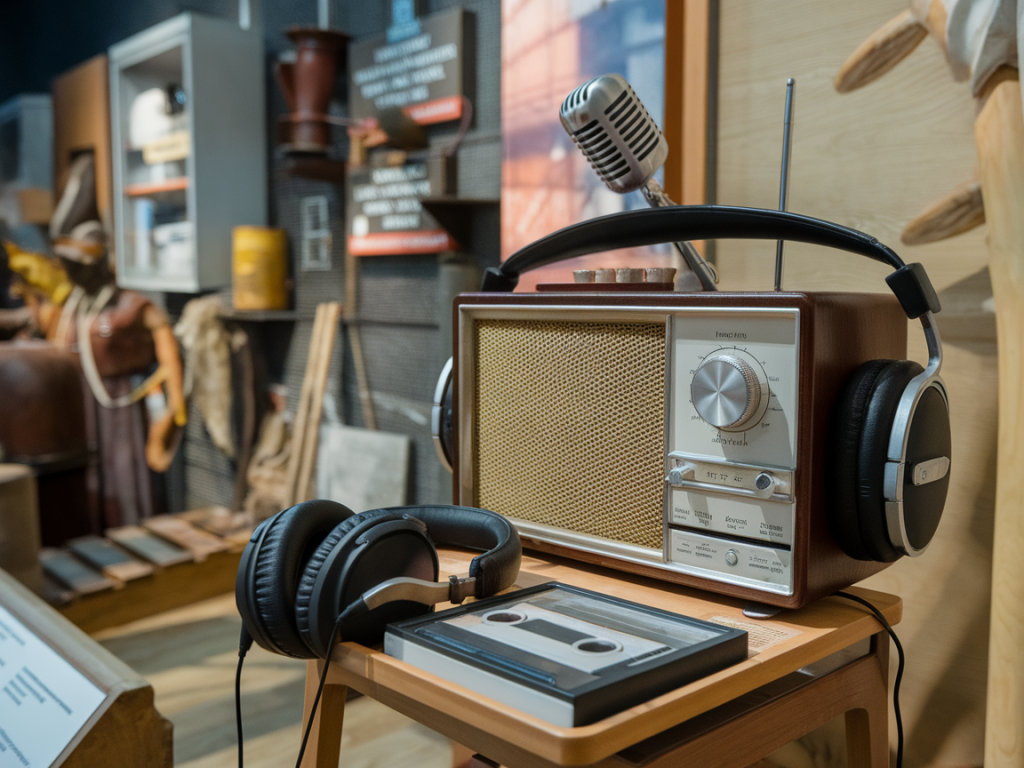
I first encountered a migrant-run radio documentary tucked away on a community station’s archive while researching oral histories for a museum project. It was raw, urgent and stubbornly intimate: the voices of seasonal workers, care workers, and parcel drivers layered over the ambient thrum of a city at night. Listening felt less like consuming an exhibit and more like being invited into a kitchen table conversation where histories and grievances were passed down in real time.
Why radio, and why documentaries?
People frequently ask me: why do radio documentaries matter for museums? Radio has a long history of reaching beyond institutional walls. Unlike a gallery label or a cabinet card, radio’s theatricality—its ability to combine voice, soundscape and narrative—creates empathy across distance. For migrant communities, radio can be immediate and accessible: it’s oral by nature, affordable to produce, and doesn’t demand literacy in the same way print does.
Migrant-run radio projects often employ documentary techniques precisely because they want to craft sustained, layered stories rather than one-off testimonies. They stitch interviews, field recordings and commentary into arcs that reveal how labour, migration and belonging are lived across decades. That depth is a powerful corrective to museum displays that reduce people to objects, dates or statistics.
How do these documentaries reshape museum narratives about labour?
At the core is perspective. Museums traditionally interpret labour through economic histories, industrial relics or canonical labour movements. Migrant radio documentaries foreground precarious, informal and feminised labour that rarely appears in institutional collections: domestic work, informal caregiving, night-shift logistics, undocumented street vending.
When curators bring these documentaries into galleries or catalogues, they’re forced to expand their frameworks. Suddenly, an artefact like a factory timecard sits beside an oral account of an undocumented cleaner who kept a neighbourhood running through the pandemic. The documentary supplies context—how shifts are organised, how communities share tips, how people keep culture alive amid exploitative employment.
In practice this reshaping happens in a few concrete ways:
- Temporal expansion: Radio archives map labour across lifetimes, rather than anchoring it to a single industrial moment.
- Informal labour visibility: Stories about gig work, domestic labour and cross-border remittances force museums to rethink what counts as ‘work worth preserving.’
- Intersectional framing: Documentaries reveal how gender, race, legal status and language intersect with employment—nuances that object-led displays often miss.
What does this mean for the idea of belonging?
Museums often present belonging as a static identity—citizenship, birthplace, or lineage. But migrant radio documentaries show belonging as contested, negotiated and deeply performative. A radio piece I worked with featured a group of Bangladeshi market traders who discussed rituals they perform on opening day, the songs that create communal confidence, and the legal gymnastics required to keep their stalls. The documentary made visible a daily practice of belonging that a label describing “Bangladeshi traders, 1980s–present” could not.
These narratives complicate spatial narratives in city museums. Instead of fixed neighbourhood histories, we get layered soundscapes: languages that have waxed and waned, festivals that reconfigure public squares, and invisible care networks that sustain multi-generational households. When museums amplify these radio documentaries, they invite visitors to hear the city in motion—sonically tracing how migrants keep infrastructures, rituals and economies afloat.
How do curators integrate migrant radio without tokenism?
Integration requires more than dropping a podcast into a digital kiosk. From my experience, the process that works involves three commitments:
- Collaboration from the start: Projects must be initiated with the producers of the radio pieces, not retrofitted to an exhibition brief.
- Shared governance: Migrant producers should have agency over how material is presented, credited and archived.
- Interpretive layering: Exhibitions need contextual panels, translated transcripts and listening spaces that respect attention and language diversity.
For instance, a partnership between a city museum and Resonance FM-style community stations I observed created a pop-up listening room within an industrial history show. The curators hung little tags on related objects—a bus route map, a work apron—with QR codes linking to the documentary segments. That simple gesture allowed visitors to cross-reference an object with lived testimony, producing a cognitive friction that deepened understanding rather than offering a superficial ‘add-on’.
Who benefits, and who decides the archive?
People often worry that museums will appropriate migrant voices for prestige or funding. That risk is real. Ethical practice requires that the originating communities benefit materially and culturally. Benefit can take several forms:
- Revenue sharing or licensing fees paid to radio producers
- Capacity-building workshops for community broadcasters on archival practice
- Joint curation models where community members co-design exhibits and educational programming
Deciding what enters the museum archive should not be a unilateral decision by curators. Migrant producers have often built robust archives—boxes of cassettes, digital folders, email threads—that deserve care and recognition. Treating those archives as collaborative holdings, rather than donations to be assimilated, is essential to preserving agency.
What challenges remain?
There are pragmatic and ethical hurdles. Audio rights can be messy: consent given to a community station ten years ago might not cover museum reproduction today. Translation is not neutral—choices about whose voice is foregrounded in an English-language label can flatten nuance. There’s also the material issue: sound-based works require infrastructure—quiet listening rooms, accessible transcripts, and staff trained in audio interpretation.
Institutional inertia is perhaps the most stubborn issue. Museums are built around objects; integrating sound effectively means reimagining spatial design, cataloguing systems and performance metrics. Yet when radio documentaries are treated as central evidence rather than peripheral ornament, museums become more porous, responsive and attuned to ongoing civic debates about labour rights, migration policy and urban belonging.
Examples that point the way
There are promising models. The Museum of London’s recent moves to include oral histories from migrant workers alongside industrial artefacts have been instructive. Smaller initiatives—community radio collectives like Migrant Voices or local Resonance FM projects—have produced documentaries that function almost as counter-archives to institutional narratives, offering granular accounts of daily survival and solidarity.
| Project | Contribution |
|---|---|
| Migrant Voices (community station) | Long-form documentaries about informal labour networks; strong community governance |
| Museum of London (oral history integration) | Pairing artefacts with listenable testimonies; public programming on labour |
| Pop-up listening rooms (various) | Low-cost, high-impact way to place radio documents within exhibitions |
When done right, migrant-run radio documentaries do more than augment museum narratives: they unsettle them. They force institutions to listen to labour in its own language—sonic, repetitive, full of humour and righteous anger—and to acknowledge that belonging is made in workplaces, kitchens and marketplaces as much as it is framed by laws and labels. For those of us working between archives and lived practice, that shift feels like the beginning of a more honest civic history.