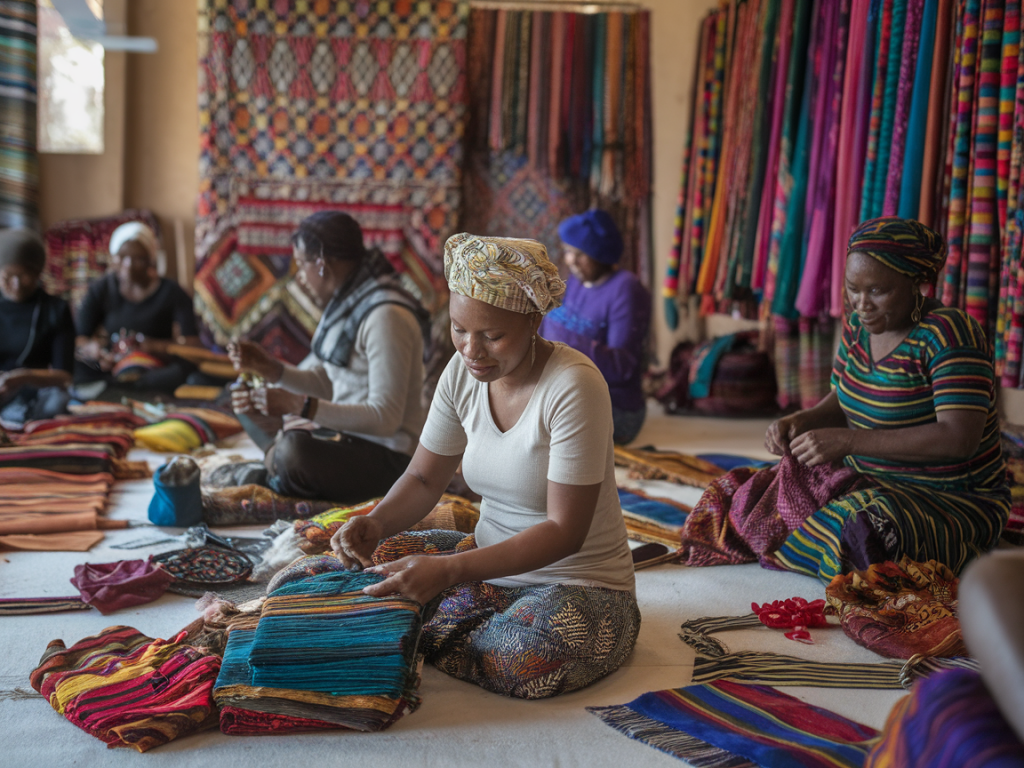
When I first began talking to textile workers in Lagos about the idea of an archive, the question that kept coming back was not simply whether their work could be sold internationally, but whether the act of archiving might extract something vital from the people and practices it sought to preserve. Could a cooperative in Lagos build a globally saleable archive of cloth, patterns and ritual contexts without turning living cultural knowledge into a commodity stripped of meaning? That question felt less like a theoretical puzzle and more like an ethical responsibility.
What do we mean by "archive" in this context?
To some, an archive is a tidy repository: photographed textiles, metadata, provenance, and a searchable database. To others it is a living collection—stories, songs, and practices tied to garments. For a Lagos cooperative working with ritual textiles, the archive must hold both forms. The challenge is how to make that material legible and valuable to global markets (museums, designers, collectors) while keeping the *contextual* knowledge—why a cloth matters, who can handle it, how it is activated—within the authority of the originating community.
Who holds the knowledge?
Ritual knowledge about textiles is seldom the property of a single individual. It is communal, often gendered, transmitted through apprenticeship and social practice. When outsiders extract patterns, colours or techniques without the accompanying cultural framework, what they acquire is a surface: design divorced from ritual meaning.
In my conversations, artisans repeatedly emphasised that the cloth's power lies in the performance around it—the incantations, the timing, the touch. Those elements, they argued, should not be packaged and sold. Yet the same artisans also wanted recognition and financial return for their labour and expertise. A cooperative can mediate these tensions if it controls how information flows outward.
Principles that might guide a non-commodifying archive
- Prior and ongoing consent: Any documentation must be consented to by the community not just once, but at stages—before, during and after digitisation or external sharing.
- Contextual integrity: Materials must carry interpretive frames created by the community: who can view, who can reproduce, and what time-sensitive or gendered restrictions apply.
- Benefit-sharing: Revenues from sales, licensing, research or exhibitions must be distributed according to cooperative rules, ideally with a portion ring-fenced for community-led cultural activities.
- Layered access: Public-facing images and metadata can exist alongside restricted archives accessible only to vetted researchers or partner institutions under agreed terms.
- Governance and legal safeguards: Cooperative bylaws, culturally appropriate licensing (e.g. custom community protocols), and partnerships with legal clinics to hold intellectual property in trust.
What models can enable both saleability and cultural protection?
Several practical models can be layered together. None are perfect but combined they offer pragmatic pathways.
| Model | How it protects ritual knowledge | How it generates global value |
|---|---|---|
| Layered Archive (public/restricted) | Sensitive rituals kept in restricted tiers with community gatekeepers | High-quality images and non-sensitive provenance data marketed to museums/brands |
| Collective Licensing | Cooperative issues licenses with terms that forbid ritual misuse | Licensing fees for designers, publishers, film productions |
| Community Curated Exhibitions | Communities retain curatorial control and narrative framing | Traveling shows, catalogues and workshops that sell publications and replicas |
| Digital Memberships and NFTs (with cultural safeguards) | Digital certificates tied to consented images, revenue shared with cooperative | Collectible digital access passes, patronage, and royalties |
Digital tools: opportunities and traps
A well-managed digital platform can make Lagos textiles discoverable to curators in Lagos, London or São Paulo. Platforms like Flickr, Omeka, or bespoke CMSs can host layered access. But digital visibility risks misappropriation: a high-resolution scan of a ritual motif can be lifted and reproduced without respect for rules. I’ve seen examples where a motif photographed for a catalogue ends up on mass-produced homeware, divorced from its cultural framework.
Technical measures (watermarks, low-resolution public images) help, but they’re not panaceas. Legal instruments—collective copyrights, community protocols embedded in licenses, and moral rights assertions—are essential. In West Africa, the conversation around traditional knowledge and intellectual property has made strides, but international IP regimes still privilege individuals and corporations, not communities.
Governance: what a cooperative should put in place
A cooperative can be a powerful vehicle because it embeds collective decision-making. Key governance elements could include:
- Charter and cultural protocol: A living document, written with community elders, artisans, and youth, setting out what is shareable and what is sacred.
- Consent processes: Standardised forms and oral-recorded consents with translators and legal witnesses.
- Revenue rules: Clear distribution models (wages, royalties, community fund, education bursaries).
- Advisory council: Elders and external curators or legal advisors who ensure ethical outreach and partnerships.
- Transparency mechanisms: Regular public reports on licensing, exhibitions, and sales.
Trade-offs and real-world pressures
We must be honest about trade-offs. Global saleability often demands packaging, storytelling and sometimes simplification. There is a commercial appetite for the "exotic" and for easily consumable narratives. Cooperatives will face offers from brands or curators that promise quick revenue but demand control over imagery and interpretive framing. Saying no is an option—but it has economic consequences. Becoming skilful negotiators is therefore vital.
One strategy is selective collaboration: working with ethical fashion labels (for instance, brands that publish supply chain transparency reports) or museums with community-led exhibitions. Another is capacity-building: training members in digital literacy, documentation practices and contract negotiation. External partners—NGOs, university departments, or cultural funders—can underwrite initial costs while the cooperative retains ownership.
Examples and precedents
I’ve looked at precedents from other regions: cooperative-run archives in Oaxaca that protect ritual dye recipes, or the Māori iwi-led archives that assert tikanga protocols for when and how taonga can be displayed. There are also cautionary tales: cases where indigenous motifs were reproduced in commercial products despite stated objections from communities. These contrasts underscore that an archive is not merely a collection but a set of relationships and obligations.
In Lagos, the cooperative could engage with platforms like the British Museum’s Community Partnerships or small ethical publishers who prioritize co-authored catalogues. They could also pursue registrations under local cultural heritage laws to strengthen their bargaining position.
Practical next steps I’d recommend
- Start with a community mapping exercise: document what is shareable and what is sacred.
- Create a pilot layered archive with a few consented items and test licensing models on small projects (zines, exhibitions).
- Build partnerships with legal clinics and ethical design houses for capacity building.
- Adopt transparent revenue models and publish them publicly to build trust.
- Train cooperative members in negotiation and digital stewardship so decisions are made locally.
Building an archive in Lagos that is both globally saleable and resistant to commodification is not only possible—it’s necessary. But it requires imagination, legal savvy, and above all, respect for the living practices that imbue these textiles with meaning. If the cooperative can retain control of the terms under which knowledge circulates, they can convert global interest into dignity, wages and cultural continuity rather than into appropriation disguised as appreciation.