I’ve watched, too many times, an object with a fraught past slip through the formal checks of an auction house and reappear decades later under a new catalogue number and a glossy photograph. It’s painful because the path that led that object from a community to a saleroom is rarely linear: it is threaded with colonial violence, illicit trade, opaque intermediaries and, often, a deep disconnect between what institutions consider “provenance” and what source communities understand as the life and meaning of an object.
What do I mean by a community-led provenance audit?
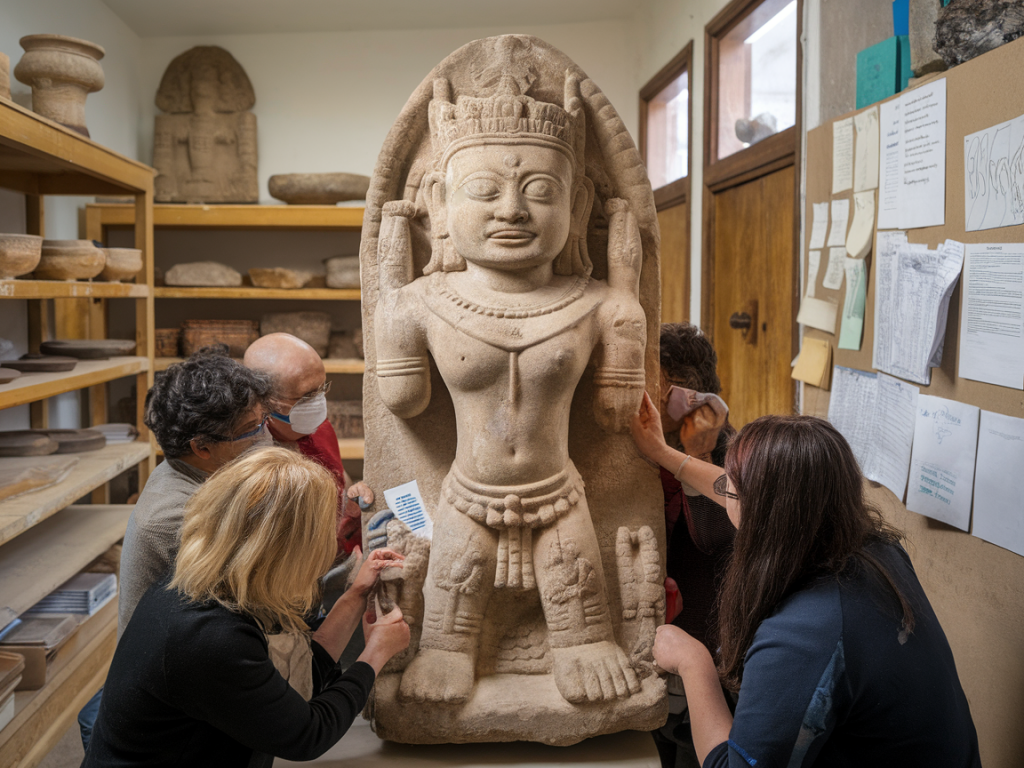
A community-led provenance audit puts the people and communities closest to an object at the centre of the research process. Rather than relying solely on dealers’ invoices, catalogue notes or collection accession files, it combines archival work, oral testimony, field research and collaborative interpretation. Crucially, the audit is not a one-off: it’s a methodology that can be applied before sale, during acquisition, and for items already in collections.
When I speak of “community”, I mean descendant communities, local custodians, ritual specialists, and anyone who holds living knowledge about an object’s history — whether that knowledge is recorded in an archive or carried in memory, song, or ritual practice. This is knowledge that auction houses and some institutions often overlook because it doesn’t fit tidy paperwork-driven provenance chains.
Why auctions are vulnerable
Major auction houses such as Christie’s and Sotheby’s, alongside smaller regional houses, operate within a commercial logic that emphasises speed, marketability and buyer confidence. Provenance checks are part of due diligence, but those checks are typically paper-based and legalistic. They often miss gaps created by colonial-era removals, informal sales, or object flows mediated by middlemen.
There is also a perverse incentive: objects with incomplete provenance can sometimes command higher prices because of their rarity, or are miscatalogued to avoid complicating sale. The high-profile cases surrounding Benin bronzes, looted Native American objects and illicit antiquities from the Middle East and Southeast Asia show how these gaps are exploited.
How community-led audits can stop looted objects reaching auction floors
Community-led audits act at several points along the supply chain:
On a practical level, these audits often reveal telltale signs — mismatches between claimed acquisition dates and oral histories, stylistic markers pointing to a region rather than a specific seller, or even photographs held by families showing the object in situ prior to its disappearance.
Methods that work
Over the past decade I’ve seen effective audits use a mix of traditional research and contemporary tools:
Examples I’ve encountered
Take the Benin bronzes: community activists, Nigerian scholars and museum curators have together compiled visual catalogues and oral testimonies that connect bronzes in European collections with palace contexts in Benin City. While national repatriation negotiations remain complex, these community-sourced audits changed the terms of the debate and forced auction houses to scrutinise bronzes more carefully.
In another case, a group working on Indigenous Australian material used old mission photographs and oral histories to identify ceremonial objects that later appeared in overseas collections. By publishing the finds and engaging media, they halted several prospective sales and initiated claims.
Digital tools and platforms that help
Technology alone isn’t a silver bullet, but it amplifies community work:
Barriers and how to address them
There are real obstacles. Auction houses argue about legal ownership, statutes of limitation, and good faith purchases. Governments invoke sovereign immunity and diplomatic sensitivity. Communities face resource constraints, language barriers and unequal power dynamics.
From my experience, these barriers are best addressed through:
What auction houses can realistically do
I’ve had frank conversations with people inside auction houses who want change but say they lack operational capacity. Implementable steps include:
Practical things readers and collectors can do today
If you collect, work in a museum, or simply follow these debates, you can make a difference:
I don’t mean to romanticise community-led audits as easy or swift. They require time, trust-building and resources. But when communities lead, the process yields richer, truer histories — and practical outcomes: objects kept out of auction catalogues, restitutions initiated, and a long-overdue shift in how we value provenance: not as a sterile paper trail but as a living narrative that belongs to people, not markets.