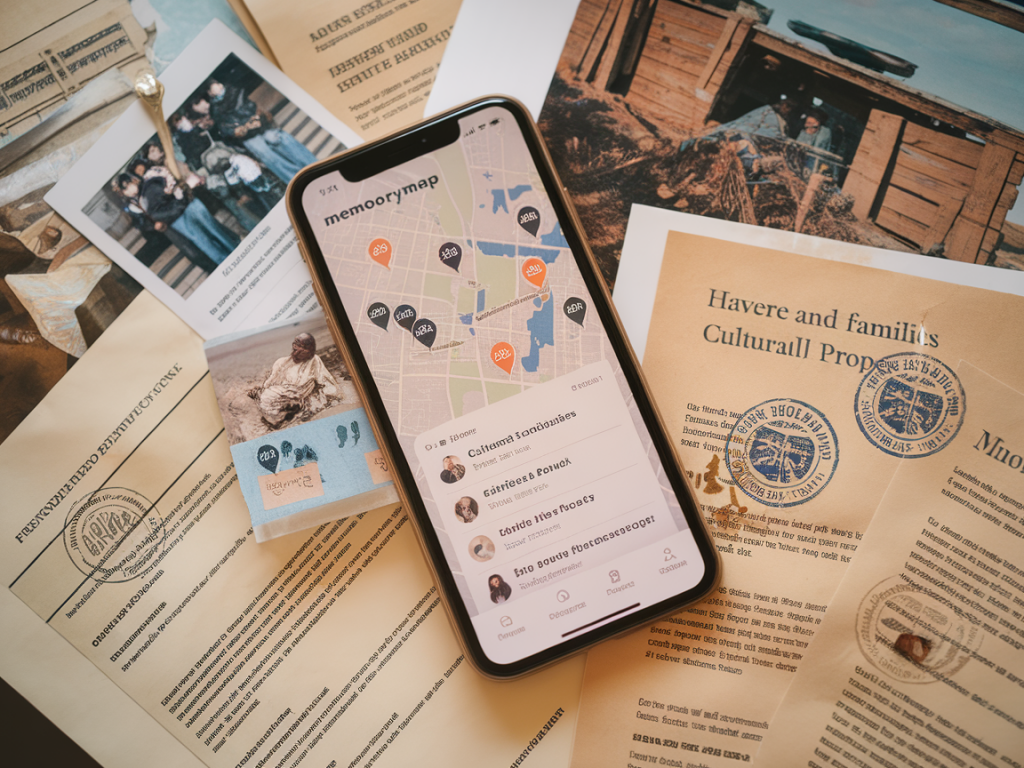
I have been thinking a lot about the ways neighbourhood apps can move beyond local listings and event calendars to become instruments of cultural restitution—practical, forensic tools that help displaced families prove ownership of cultural property in court. The app I like to imagine, which I'll call MemoryMap, combines community-driven documentation, timestamped multimedia, geolocation, and interoperable digital records. But how exactly could such an app produce evidence admissible in legal settings? And what are the ethical and technical pitfalls we need to anticipate?
What MemoryMap would actually record
At its core, MemoryMap is a platform that lets families and communities document objects, oral histories, photographs, and provenance stories attached to cultural items—anything from domestic heirlooms to ritual objects, textiles, or photographs of ancestral homes. It captures:
These data points are useful on their own, but their value increases when combined into a structured, auditable record that a court can evaluate alongside other evidence.
How courts typically assess ownership of cultural property
From my experience reporting on heritage disputes, courts look for a few key elements: chain of possession (who had the item and when), provenance (commercial or familial history), credible witnesses or documentary evidence, and the absence of competing good-faith acquisition claims. MemoryMap can help address these criteria if designed and used with the legal context in mind.
Proving chain of possession with MemoryMap
Chain of possession is about establishing continuity. MemoryMap can support that by:
If entries were created contemporaneously—say, a photo taken and uploaded shortly after an object was moved—that contemporaneity adds weight in court. I’ve seen judges give persuasive value to records that are dated close to the events they describe.
Provenance and documentary evidence
Proving provenance often depends on documentary trails: purchase receipts, inventory lists, exhibition catalogues, or correspondence. MemoryMap should allow users to attach scans and transcribe key passages. OCR (optical character recognition) and metadata extraction can make records searchable and easier to present in court.
Equally valuable are oral histories. Courts increasingly accept recorded testimony as corroborative evidence—especially when accompanied by contemporaneous documentation. An audio clip of a grandparent explaining that an embroidered cloth was made for a wedding in 1952 and used every generation can be powerful when paired with dated photos showing the cloth in the family home.
Technical measures to strengthen evidentiary weight
Not all digital records are created equal. To maximise admissibility, MemoryMap can implement several technical safeguards:
Legal and evidentiary challenges
Despite these measures, there are limits. Courts may question:
MemoryMap will need to anticipate forensic scrutiny. That means offering provenance metadata, hashing, and the ability to produce original device files or logs if requested through proper legal channels.
Privacy, consent and ethical considerations
I can't stress enough that MemoryMap must centre ethics. Communities are often vulnerable; photos and oral histories can expose sensitive information or risk appropriation. The app must include:
Practical workflow for using MemoryMap in a legal case
Here's a plausible workflow I find convincing:
What I would advise families and advocates today
If you're considering using an app like MemoryMap, start by documenting everything now—photos, full captions, names of witnesses, and any paperwork you have. Use trustworthy platforms that support metadata and exportable records. Where possible, get notarised statements from local officials or community leaders. And consult a lawyer early so you can tailor documentation to your jurisdiction's evidentiary standards.
MemoryMap won't be a magic bullet, but it can shift the balance by turning fragile oral histories and scattered photographs into a coherent, timestamped archive. To make that archive persuasive to courts, designers, communities and lawyers will have to collaborate—asking hard questions about trust, consent and technical integrity every step of the way.