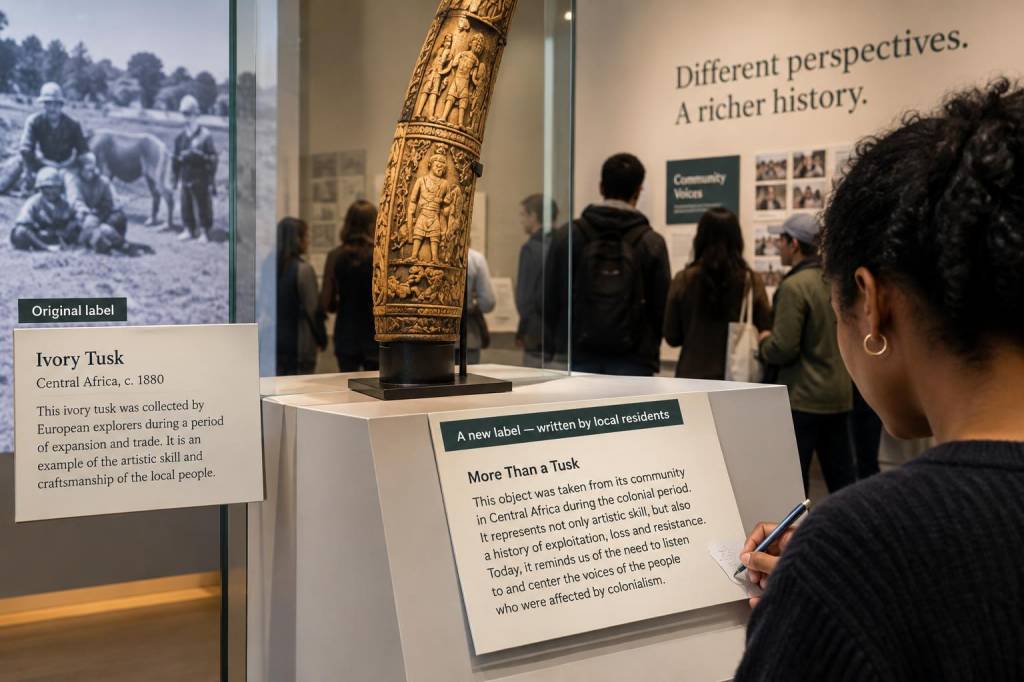
I still remember standing in a small gallery where a colonial-era object sat inside a glass case, polished by time and by institutional caution. A brass plaque nearby offered a neat, authoritative story: date, place, donor, material, function. It was tidy, confident, and strangely silent. A group of residents had been invited to rewrite that label, and what unfolded was not a simple exercise in wording. It became a test of who gets to name history, whose memory counts, and whether a museum can live with uncertainty instead of hiding behind certainty.
When a local museum asks residents to rewrite the label for a contested colonial object, it is not just asking for a fresh paragraph. It is asking people to enter a space where knowledge, grief, pride, anger, and inherited silence collide. I have watched this kind of project begin with excitement and end in discomfort, which is often a sign that something real has happened. A label may be only a few sentences long, but it can carry decades of omission. If you open that space to residents, you are no longer dealing with interpretation as a specialist’s private domain. You are letting the public touch a nerve.
Why a label matters more than it seems
Museum labels can look minor, almost bureaucratic. Yet they shape what visitors think they know before they have time to question it. A single line can present a colonial object as an exotic curiosity, a spoil of empire, a sacred item, or a “gift” that arrived through violence, pressure, or coercion. Labels frame morality as much as they frame history. They tell visitors whether an object is admired, mourned, disputed, or still under debate.
That is why local residents are often the people most capable of breaking a museum out of its habit of certainty. They may carry family stories, neighborhood memory, linguistic knowledge, or lived experience of the power relations that shaped the object’s arrival. In my experience, once a museum admits that a label is not neutral, it opens a difficult but necessary question: neutral for whom?
What makes these projects powerful is not that residents magically agree. They usually do not. A label workshop can expose deep divisions inside a community. Some people want strong moral language. Some want restraint. Some want the object returned. Some want it displayed with honesty, even if it remains in the building for now. The friction is not a failure; it is part of the truth.
What changes when local voices enter the room
I have seen museum staff arrive prepared for a polite consultation and leave with a much messier, richer understanding of place. Residents do not speak like catalogue copy. They speak in memory, frustration, irony, and sometimes in very plain language that cuts through institutional phrasing. They ask questions that curators may have learned to avoid: Who benefited from this taking? Why is that violence softened here? Why does this object still sit here while the story around it stays incomplete?
That shift can be uncomfortable for staff, especially if they have spent years mastering careful wording. But discomfort can be productive. A contested colonial object is not simply an artifact; it is a relation. It links museum practice to empire, trade, extraction, scholarship, and public memory. When residents help rewrite the label, they often force a museum to acknowledge that its display language has been part of a larger system of power.
At its most honest, the process does more than improve interpretation. It changes authority. Curators remain responsible for context, accuracy, and care, but they are no longer the only voices shaping meaning. That may sound modest, yet it can transform a museum from a place that speaks about communities into a place that listens with them.
What residents usually ask for
Although every project is different, I have noticed a few recurring demands from residents involved in label rewriting:
- Clear acknowledgment of colonial extraction, coercion, or unequal power.
- Plain language that avoids euphemism and institutional vagueness.
- Specific provenance rather than vague references to acquisition.
- Recognition of harm done to source communities or descendant communities.
- Space for uncertainty when records are incomplete or disputed.
- Local relevance that explains why a distant object matters now.
- Respectful tone that does not collapse into either sensationalism or sterile neutrality.
These requests sound simple, but they often challenge longstanding museum habits. A label may have been written to sound objective, yet objectivity can become a shield for avoidance. Residents tend to notice that immediately. They are often less interested in preserving institutional polish than in making sure the text does not repeat the original harm by erasing it once more.
Where the process can go wrong
I would be dishonest if I pretended every participatory label project succeeds. Some are tokenistic from the start. A museum invites residents, collects emotional testimony, then keeps final editorial control without changing much at all. In those cases, participation becomes decoration. The institution appears open while leaving its narrative untouched.
Another failure point is speed. Real dialogue takes time, and contested heritage cannot be resolved in a single evening workshop. If a museum wants residents to rewrite a label, it must be willing to sit with disagreement, revise drafts, and accept that the final text may remain provisional. A rushed process produces bland compromise or polite evasion. Neither is worth the effort.
There is also the risk of overloading a label. A few lines cannot repair colonial history, return stolen material, or resolve every political dispute. If a museum expects the label to do everything, it will fail. A label can start a conversation, but it cannot carry the full burden of justice on its own.
What a stronger label can actually do
Even with those limits, a rewritten label can change the atmosphere of a gallery. It can invite visitors to pause, question, and read differently. It can signal that the museum understands this object as part of an unresolved history rather than a frozen relic of a finished past. It can also make room for more honest emotional responses. Visitors are often more capable of engaging with difficult heritage when they see that the institution itself is not hiding behind false certainty.
I think of a label as a threshold. Visitors cross it and enter a story. If that threshold is narrow and controlled, only one interpretation gets through. If it is open and carefully shaped, more than one voice can speak. That does not mean every viewpoint deserves equal weight. It means the museum has a duty to distinguish evidence from myth, interpretation from propaganda, and accountability from denial. But it also means admitting when a single institutional voice is not enough.
| Label style | Visitor effect | Institutional risk | Public value |
|---|---|---|---|
| Authoritative and closed | Clear but passive reception | Erasure of conflict | Low trust over time |
| Participatory and revised | Active reading and questioning | Visible disagreement | Greater honesty and relevance |
| Vague and cautious | Confusion or indifference | Avoidance of responsibility | Weak interpretive value |
| Direct and contextual | Sharper understanding | Exposure of past harm | Stronger civic dialogue |
What I notice in the room when people rewrite history together
The most revealing moments are often small. Someone corrects a date because their family archive says otherwise. Someone else names a place in a local language that had been absent from the museum text. A resident pauses over a phrase like “collected” or “acquired” and says, almost quietly, “That is not what happened.” The room changes when that sentence is spoken. It is not just a wording issue anymore; it is a moral reset.
I have also seen people become unexpectedly generous in those moments. Even those who arrive angry often want accuracy more than revenge. They want the label to carry enough truth that a child, years later, can read it and understand that history was not innocent. That kind of generosity should not be mistaken for acceptance. It is a demand for seriousness.
For museums, the challenge is to avoid treating that generosity as a free resource. If residents help rewrite a label, they should not be expected to perform reconciliation for the institution. Their labor has value. Their time has value. Their knowledge has value. Too often, heritage work asks communities to contribute insight while the museum retains prestige and control. A fair process recognizes that imbalance and names it.
What I would want a museum to say out loud
If I were standing with the curators, residents, and object all in the same room, I would want the museum to say something simple and difficult: we do not own the final truth, and we are willing to let this label show that. Not confusion for its own sake, not sloppy scholarship, but honest openness about what is known, what is disputed, and what has been ignored.
That honesty can be unsettling because it weakens the old fantasy that museums merely preserve and present. In reality, they interpret, select, omit, and frame. Once residents are asked to rewrite a label, that fact becomes visible. The museum can either retreat into defensiveness or accept that public trust grows not from perfection but from accountability.
And perhaps that is why these projects stay with me. A label is small, but it can make visible an entire ethics of display. When local residents are asked to rewrite a contested colonial label, they are not only editing text. They are renegotiating belonging, memory, and authority in a public room where history is no longer permitted to speak in a single voice.