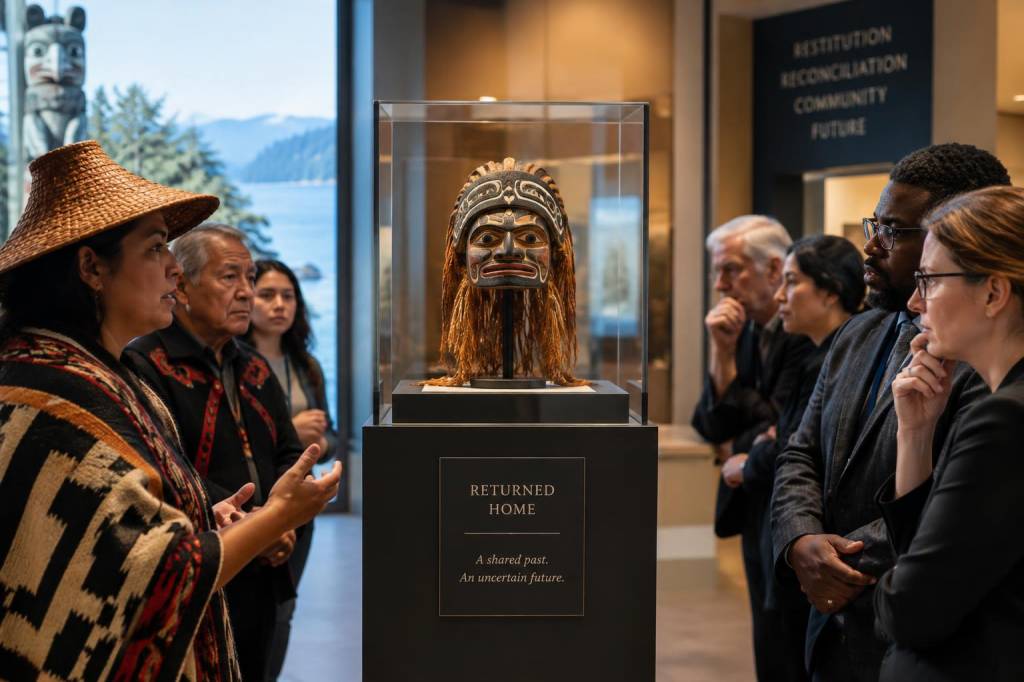
I have sat in rooms where a returned sacred object changed the atmosphere before anyone spoke. People sat straighter. Voices dropped. Some looked relieved, others guarded, and a few seemed to be carrying generations of unresolved grief in a single meeting. In moments like that, I am reminded that return is never only about logistics. It is about memory, authority, repair, and, very often, disagreement.
When a sacred object comes home, many people imagine that resolution follows naturally. I wish it did. In my experience, return can open a harder question: who now has the right to decide what happens next? A community may agree that an object should no longer remain in a museum, yet still disagree about whether it should be buried, displayed, used in ceremony, conserved in a cultural center, or kept in a restricted place. These are not minor differences. They can expose old fractures, competing kinship lines, religious obligations, political histories, and unequal access to power.
Return does not automatically create consensus
One of the most common mistakes I see in heritage work is assuming that restitution ends conflict. It rarely does. A museum may return a sacred object after years of advocacy, negotiation, and public scrutiny, but once it arrives, the object enters a living social field. A returned item may carry ceremonial expectations, legal questions, family claims, and emotional weight that no archival report can fully capture.
I have learned to treat return as a beginning rather than an endpoint. The object is no longer housed within the museum’s walls, but it is still surrounded by institutional habits: paperwork, conservation language, expert opinion, and, sometimes, an assumption that a single community spokesperson can speak for everyone. That assumption can be deeply damaging. Communities are not uniform. Elders may disagree with younger members. Religious authorities may differ from cultural custodians. Diaspora members may see the future differently from those living near the object’s place of origin.
If I were advising a museum in that situation, I would say this: do not confuse possession with clarity. Once the object returns, clarity must be built through patience, not imposed through administrative convenience.
Listen for disagreement instead of trying to erase it
When people tell me a community “cannot agree,” I usually ask a second question: cannot agree, or has not been given the right conditions to disagree safely? There is a difference. Healthy disagreement requires time, trust, and a process that does not punish minority voices. In many heritage contexts, disagreement has been flattened because outside institutions have preferred a single narrative. That habit does not disappear simply because an object has been repatriated.
I think museums can do something surprisingly important here: they can model careful listening without taking over the decision. That means creating spaces for discussion, documenting different positions accurately, and resisting the urge to force compromise for the sake of a neat public story. If one group wants the object displayed under controlled conditions while another wants it kept out of public sight, that tension should be acknowledged honestly. It should not be hidden behind phrases like “community consensus” unless consensus truly exists.
In practice, I have seen better outcomes when institutions do not ask, “What is the single right answer?” Instead they ask, “What are all the responsibilities attached to this object, and who is carrying them?” That shift matters. It moves the conversation away from ownership and toward stewardship, responsibility, and relational care.
Different futures may all be legitimate
People often assume there is only one proper fate for a sacred object after return. In reality, several futures may be ethically defensible. An object might need ritual reactivation. It might need to remain hidden from public view. It might be conserved for future generations. It might circulate among families or ceremonial specialists. It might be photographed, studied, or narrated in a community archive. Each option can carry both value and risk.
I have found it useful to map those possibilities openly rather than treat one as morally superior from the start. For example:
- Some communities may prioritize ritual use over physical preservation.
- Some may want restricted access for cultural or spiritual reasons.
- Some may value public education and controlled exhibition.
- Some may see a need for intergenerational consultation before any final decision.
- Some may want the object to remain in a specific place tied to ancestral memory.
None of these positions is inherently trivial. Each reflects a different understanding of care. A museum that truly respects return must recognize that preservation is not always the highest value, and visibility is not always a public good. Sometimes silence, enclosure, or ritual separation is what care looks like.
Who gets to speak for a community?
This question sits at the heart of nearly every difficult repatriation case I have encountered. Museums like clear lines of authority. They want a legal custodian, a board, a chief, a trust, a ministry, or a designated representative who can sign a form and close the matter. But sacred heritage rarely fits neatly into legal paperwork.
I am wary of institutions that rush to identify one voice and treat everyone else as background noise. Authority can be real and necessary, but it can also be contested, historical, and unevenly distributed. A signatory may have legal standing while lacking moral legitimacy. A respected elder may hold ritual authority while not speaking for all descendants. A youth group may lack formal power yet carry the strongest vision for the object’s long-term care.
My instinct is to ask museums to support plural representation. That might mean convening several stakeholders, not just one, and making room for disagreement without forcing it into a public relations script. It may also mean working with facilitators who understand local dynamics, language differences, and the risk of internal pressure. In some cases, a museum can help by funding dialogue without directing it.
Here is a simple comparison I often use when thinking through options:
| Possible approach | Strength | Risk |
|---|---|---|
| Single representative decision | Fast, clear, administratively simple | May exclude important voices |
| Extended community consultation | More inclusive and transparent | Can be slow and emotionally demanding |
| Shared stewardship arrangement | Allows flexible care responsibilities | Requires ongoing trust and resources |
| Temporary holding period after return | Buys time for reflection and ritual preparation | Can feel like delay if poorly explained |
None of these models is perfect. What matters is whether the process remains accountable to the people for whom the object carries sacred meaning.
Care is practical, emotional, and political
I often think museums underestimate how much labor comes after return. There is the physical handling of the object, of course, but also the emotional labor of meetings, mediation, and public expectation. People may arrive carrying unresolved anger at colonial extraction, broken promises, or family disputes that have never been acknowledged. If those feelings are ignored, even a successful return can become brittle.
That is why I believe museums should invest in support structures, not just ceremonial moments. This can include funding for convening, translation, travel, archival access, and local hosting. It can also include space for grief. A returned sacred object may not be “celebrated” in the public sense. It may require privacy, or a slower pace, or a period of observation before anyone decides what comes next.
I also think museums should accept that their role may be smaller than they hope. Sometimes their most meaningful contribution is to step back, provide resources, and leave decision-making where it belongs. That can feel uncomfortable inside institutions trained to manage objects and narratives. Yet humility is often what makes repair possible.
Transparency matters more than certainty
If I had to name one principle that should guide museums in these situations, it would be transparency. Not perfect certainty, not instant agreement, but honest process. People deserve to know who is being consulted, what disagreements exist, what resources are available, and what limits shape the final decision. Hidden procedures breed suspicion. Open process, even when imperfect, gives people a chance to trust that they are being treated fairly.
Transparency also protects the museum itself. If a decision is made quietly by a small circle, later conflict may be interpreted as bad faith. If the institution documents the range of views, the constraints, and the reasons for each step, it creates a record that acknowledges complexity rather than disguising it.
In my own work, I have come to value a slow, layered process that leaves room for revision. A returned sacred object may eventually settle into a stable practice, but that stability should not be rushed. Communities change. New generations inherit responsibilities. What feels impossible today may be resolved differently in five years. A museum that recognizes this will not demand a permanent answer immediately. It will support an ongoing relationship.
What I believe museums owe after return
When I am asked what museums should do when a sacred object returns home but the community cannot agree on its future, my answer is never a neat formula. I believe museums owe respect, patience, resources, and a refusal to dominate the process after claiming moral credit for the return. They should help create conditions for conversation without forcing consensus. They should accept that sacred objects are not inert property but active participants in social life, carrying obligations that may outlast any single negotiation.
I also believe museums should be prepared for a future in which their own expertise is only one voice among many. Conservation knowledge matters. Curatorial history matters. Legal clarity matters. But those forms of knowledge do not outrank spiritual authority, kinship memory, or local ceremonial practice. If return means anything, it must mean a redistribution of power as well as a change of location.
That is why I return again and again to the same simple but difficult idea: once a sacred object comes home, the real work begins in how people care for its future together, even when agreement remains out of reach.