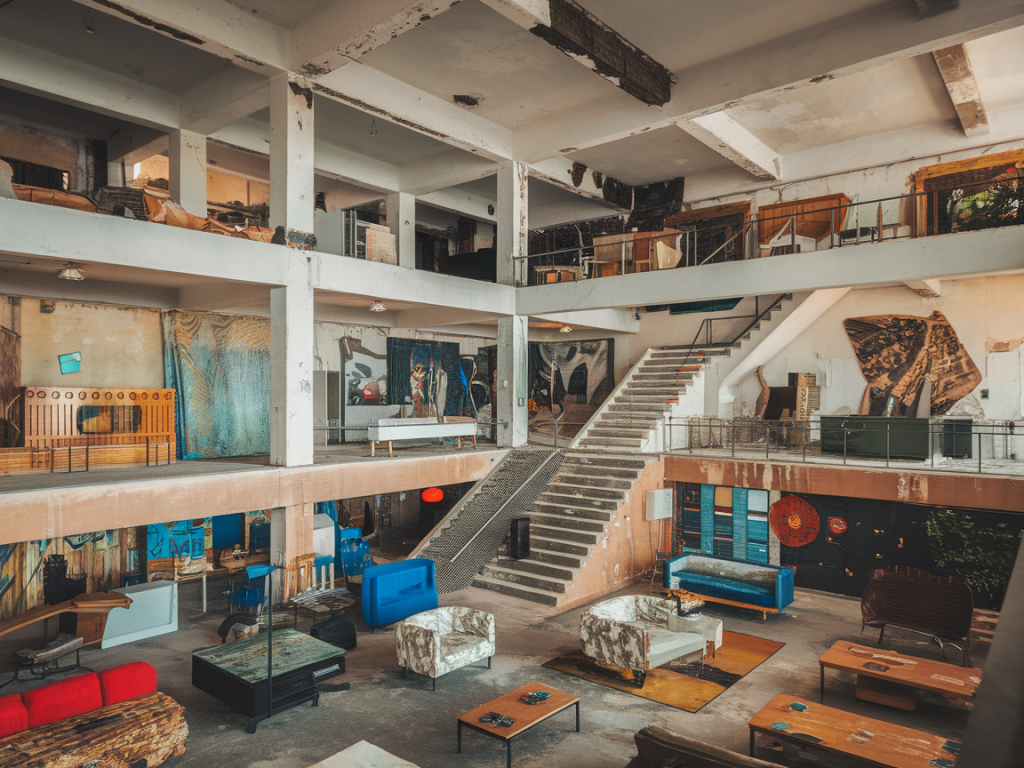
I first stumbled upon the cooperative by accident, on a rain-washed afternoon in Lisbon when the city's usual postcard charms felt suddenly thin. I was looking for something rawer than the Alfama tourist loop — a place where the past didn't just hang on walls as pretty tiles but still smelled faintly of oil, metal and other human labour. The cooperative's entrance was an unmarked gate set between two crumbling warehouses; inside, the space unfolded like a reclaimed chapter of the city's industrial biography. That encounter has stayed with me: it felt less like a visit than an initiation into a living archive.
What is this cooperative and why does it matter?
The group calls itself Oficina Comum (a fictional but plausible name for the purposes of this piece), a loose collective of artists, makers and cultural workers who, over the past five years, have been transforming a long-abandoned factory in Marvila into a hybrid studio-archive-performance space. Their project matters because it does three things at once: it rescues a piece of built heritage from dereliction; it creates affordable, shared workspace for creative practitioners; and it deliberately frames its activity as an act of collective memory-making.
People often ask me: isn't this just another example of gentrification-by-culture? My answer is careful and lived-in. Yes, creative projects can be harnessed as placemaking tropes that precede real estate development. But Oficina Comum has tried — imperfectly, sometimes painfully — to put safeguards in place. Their lease is a time-limited, cooperative arrangement with clauses that prioritise community use, and they've created a rotating governance model where decisions are taken in open assemblies. In practice that hasn't eliminated tension with developers and local residents, but it reshapes the terms on which the space exists.
How does an industrial site become a cultural memory?
Converting a factory into a cultural hub requires more than renovation; it requires translation. The cooperative's members work like translators between different languages of value: the technical language of infrastructure, the oral language of workers' stories, and the symbolic language of contemporary art. Their process blends conservation — stabilising roofs, exposing brickwork, keeping original signage — with creative interventions that make the factory's histories legible.
One of their early projects was a listening station built inside a former boiler room. Volunteers recorded oral histories from retired machinists, seamstresses and dockworkers who once made their livelihood within a five-kilometre radius. The recordings are raw and conversational: conversations about shift rhythms, about lunchtime sandwiches, about the slow arrival of automation. Hearing those voices in situ — the metallic echo of the boiler room giving shape to the narratives — turned the interior into a layered memory space. Visitors don't just see artefacts; they hear the cadence of labour that produced them.
Who is involved, and how are decisions made?
The cooperative is intentionally heterogeneous. It includes painters, ceramicists, sound artists, social historians, a couple of architects, and even an archivist who runs a pop-up reference library. They meet weekly in the courtyard under string lights that used to hang between production sheds. Decisions are taken by consensus where possible; for more contested matters they use a modified sociocratic process. It is slower than a top-down structure, but it builds legitimacy.
Funding comes from a mix of small public grants, micro-patronage from a handful of European foundations, income from workshops and residencies, and a modest membership fee. They also barter: a carpenter will trade joinery for a month of studio time, a ceramist will teach a pottery class in exchange for wood-fired kiln access. These economies of exchange are crucial because they create material interdependencies that anchor the project locally rather than turning it into a passive cultural showcase for visitors.
What kinds of programmes and events take place there?
The cooperative's activity calendar refuses neat genre boundaries. You can enter on a Tuesday to find a zine workshop, and on a Friday there’s a screening of documentaries about post-industrial Portugal. They host:
One particularly striking programme pairs ceramicists with former tile factory workers. Participants produce a new tile series that references traditional motifs, then reinstall the tiles in a derelict wall. The new tiles are not an attempt to replicate a past aesthetic — they act as a conversation between makers across generations. It feels like a small act of restitution.
How does the cooperative balance preservation with innovation?
There is no single formula. They follow a pragmatic ethic: preserve what tells a story, adapt what is functional, and intervene where necessary to sustain creative practice. Rather than gutting interiors for pristine galleries, they keep traces of industrial life visible — grease stains, steel beams, faded signage. But they also invest in essential upgrades: proper insulation, accessible bathrooms, fire safety. These upgrades are often funded by collaborative grant applications where cultural heritage agencies and arts funds contribute in tandem.
Importantly, the cooperative resists museumification. Their archive is not meant to be a sealed vitrined object. It is an active collection: objects are used in workshops, garments are mended in public view, and tools are loaned. This "useful heritage" approach creates a living memory that is felt through touch and repetition, not just observation.
What challenges do they face?
There are many. Securing sustainable funding is persistent and exhausting work. Navigating property law and local planning regulations in Lisbon — where speculative pressures are real — requires both legal know-how and political bandwidth. They also wrestle with inclusivity: how to ensure that working-class neighbours feel welcomed and represented, rather than merely observed. Language can be a barrier too; many residents are older and speak only Portuguese, while some artists and funders prefer English. Oficina Comum invests in translation and community outreach to bridge that gap.
Another challenge is the ever-present question of legacy: when the cooperative's lease ends, who will hold the memory that has been cultivated? To mitigate that risk, they have established a digital repository and distributed ownership model for the archive, ensuring that physical materials and oral histories are duplicated and accessible to partner community centres across Lisbon.
Why visit or support a project like this?
When I walk through the cooperative's courtyards, I feel the particular pleasure of a place that refuses the flatness of polished cultural consumption. It's messy, human and argumentative in the best way. Supporting such initiatives — whether by attending a workshop, donating a small sum, or advocating for policy that protects cultural commons — is a way to keep urban memory plural and grounded.
If you visit Lisbon and want a cultural experience that moves beyond postcard façades, look for places that preserve not just objects but the conditions of their making. Oficina Comum is not a perfected formula; it's a set of practices and decisions that make room for a collective past and a shared future. It’s precisely the kinds of projects I try to highlight on Sacredskulls Co: work that complicates easy narratives and asks us to rethink how cities remember the labour that built them.