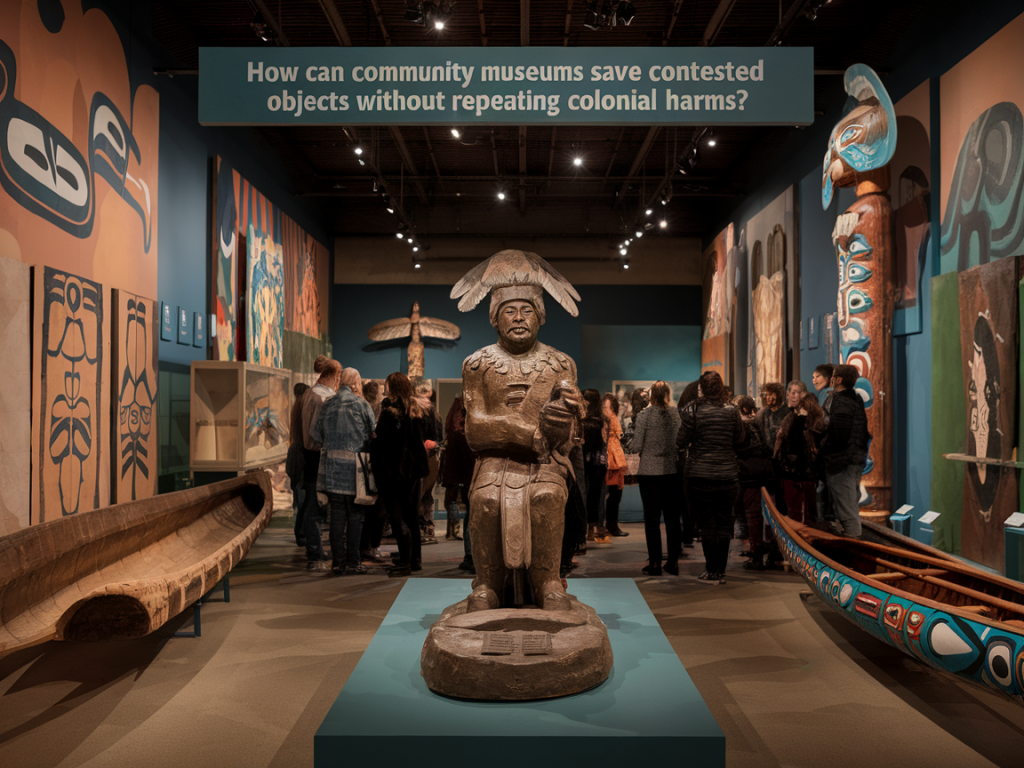
When museums claim to “save” objects from neglect, they too often inherit stories of dispossession. I’ve listened to elders in Caribbean parishes, artists in Lagos and curators in provincial British towns who asked me the same question: how do we steward contested objects without repeating the very colonial harms that put these items on display in the first place? The answer, as I’ve learned through research and long conversations, is less about decisive repossession and more about shifting power—toward community, context and care.
Rethinking the verb “save”
“Saving” implies rescue and ownership. In museum practice that often translates into acquisition, cataloguing, display and interpretation under institutional authority. But when objects are contested—looted ritual objects, human remains, colonial-era trophies, or artefacts taken under unequal treaties—the act of preservation can replicate harm if it ignores the people to whom that object matters most.
I’ve become skeptical of unilateral rescue narratives. Instead, I suggest a different verb: steward. Stewardship foregrounds temporary guardianship, collective responsibility and an ethics of return. It accepts that museums may hold objects for a season while prioritising relationships that can lead to restitution, shared custody or community-led interpretation.
Center the source communities from the start
One pattern I keep returning to is the difference between consultation and co-governance. Too many institutions consult communities as a checkbox—invite someone to a preview or run an advisory panel with little decision-making power. That’s not enough. If a museum seeks legitimacy in caring for contested objects it has to invite source communities into governance, financial planning and interpretive authority.
- Governance: Create seats on boards or advisory committees for community representatives with voting rights, not just symbolic roles.
- Budgets: Allocate funds explicitly for community programming, travel, and capacity-building—don’t hide these costs in a vague outreach line.
- Decision-making: Share control of exhibition narratives, loans and research priorities. Decide together when an object should be displayed, stored, or returned.
During a recent project I observed how a provincial museum in France transformed its approach by signing a memorandum of understanding with a diasporic community association. The agreement stipulated joint curatorial control for three years and funded a community archivist post. The museum’s staff told me they learned more about care practices in six months than in a decade of conventional curatorial work.
Respect living protocols and care practices
Objects are not inert. For many cultures they are entangled with rites, rights and relations. Conservation methods developed around western museum climates often strip objects of their social life. That’s why I advocate for flexible care regimes that respect living protocols.
- Ask communities how objects should be handled, stored, displayed and when they should not be displayed.
- Incorporate traditional custodial roles into collection care—hire cultural specialists from source communities as curators or custodians.
- Allow for practices such as periodic cleansing, wrapping or ritual that might seem unconventional in a museum context.
In one case a university museum agreed to house sacred cloths on loan under conditions set by the custodial family, including seasonal removal for ritual and storage in a wooden chest made by local artisans. Conservators had to adapt: climate control standards were relaxed in favour of respectful handling protocols. The result was deeper trust and better preservation of meaning, not just material.
Design shared narratives, not single-author stories
Museum labels and gallery interpretations shape how publics understand history. When objects are contested, interpretation must be polyvocal. I’ve seen exhibitions that combine community testimonies, archival documentation, and contemporary artistic responses. These displays don't aim for a single “truth”; they model dialogue.
Effective practices include:
- Co-authored labels and audio guides with community members, historians and artists.
- Rotating displays where different voices lead the narrative at different moments.
- Digital platforms—websites, podcasts or apps—where extended community contributions can be hosted beyond gallery constraints.
Platforms such as Omeka or StoryMapJS can help institutions present these layered narratives accessibly. I’ve encouraged teams to pair a physical loan with a digital archive curated by source communities, offering richer context and democratic access.
Legal tools and alternative restitution models
Not every contested object will be returned immediately. Legal frameworks are complex—but that should not prevent creative solutions. Shared custody agreements, long-term loans, cultural exchanges and community-led exhibitions are viable interim models that respect rights while navigating legal hurdles.
| Model | When it helps | Risks |
|---|---|---|
| Permanent restitution | Clear provenance and legal/ethical claims | Institutional resistance; resource transfer challenges |
| Long-term loan | Repair relationships; enable community access | Perpetuates institutional retention in some cases |
| Joint custody | Fosters shared care and co-curation | Logistics, conservation standards differ |
| Digital repatriation | Access when physical return is impossible | Doesn’t replace material and ritual significance |
My view is pragmatic: use legal tools where possible, but don't wait for perfect solutions to begin meaningful collaboration.
Invest in capacity-building and reparative funding
Restitution is not simply an object transfer; it requires resources for housing, conservation, curatorship and community programming. Museums that intend to return or co-manage objects must invest in long-term capacity-building—training, infrastructure grants and institutional partnerships that transfer skills and resources.
- Establish micro-grants for community museums to build storage and care facilities.
- Offer training fellowships in conservation, cataloguing and digital archiving.
- Create staff exchange programs so institutional knowledge can be shared bi-directionally.
I’ve seen foundations and councils fund such programs, but they are still the exception. We need more structural funding from national bodies and philanthropic organizations that recognise the costs of repair.
Measure success differently
Success cannot be measured solely by how many objects a museum retains. Instead, evaluate outcomes like strengthened community governance, improved access, enriched narratives, and reduced harm. Ask how relationships have changed, whether storytelling authority has shifted and if custodial burdens are being addressed equitably.
Metrics might include:
- Number of community members in decision-making roles
- Funds redistributed to source communities
- Instances of co-produced exhibitions and publications
- Qualitative feedback from communities about care and respect
When institutions reframe their mission toward stewardship, they open space for practices that honour both objects and the living people whose lives they shape. It’s neither neat nor easy—but it’s essential if museums are to stop repeating the histories they once helped to tell.